
Vattenfall achieves safer and climate smarter seabed inspection with uncrewed vessels
Vattenfall has conducted the first large-scale seabed survey with uncrewed surface vessels. The results were very positive, both from a climate and a safety aspect. This opens up for a broader use of this new technology.
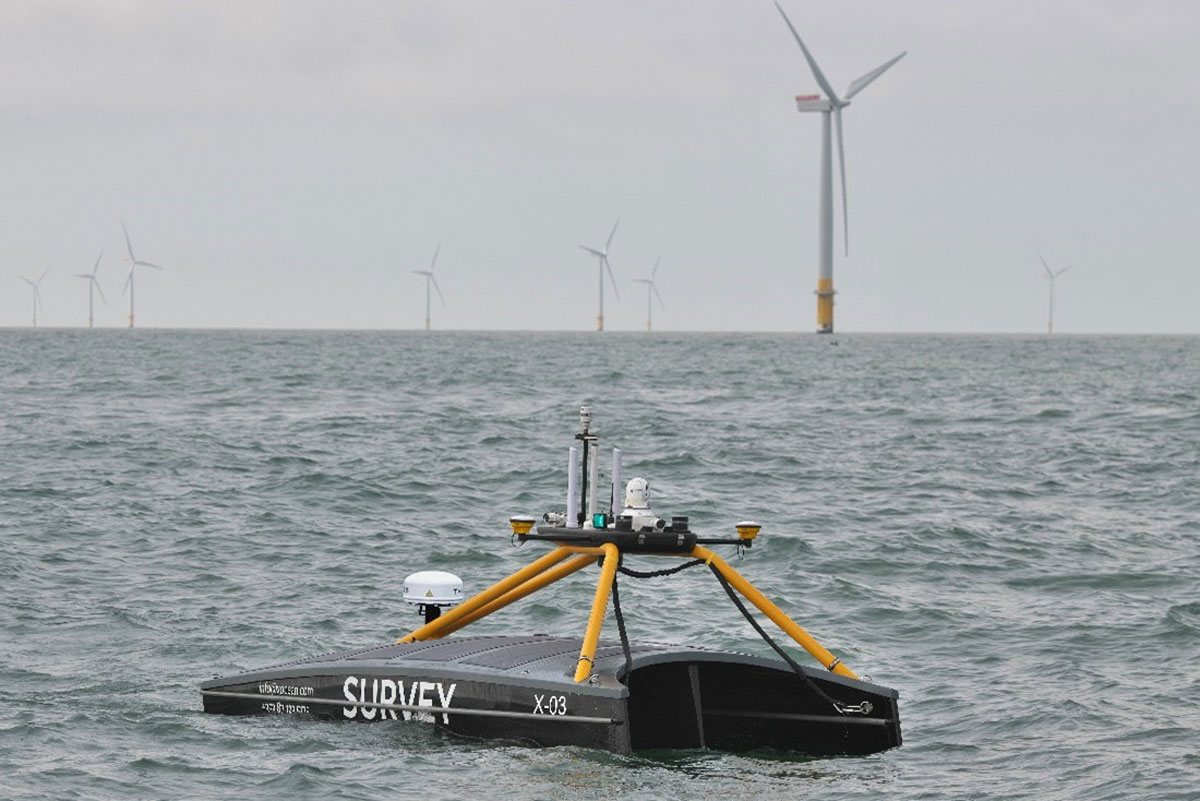
In the late summer and early autumn of 2022, Vattenfall successfully conducted large scale seabed surveys with uncrewed surface vessels. The surveys were conducted at several of Vattenfall’s offshore wind farms in Denmark, Sweden and the UK.
As a part of operating an offshore wind farm it is necessary to periodically survey the seabed around turbine foundations and substation jacket legs to monitor changes in cable burial depth and scour development. This knowledge is also important for repair and maintenance activities involving jack-up vessels, where legs require a stable seabed to ensure safe elevation out of the water.
Traditionally, seabed surveys are carried out using crewed vessels, which emit substantial amounts of carbon from the consumption of fuel.
“When we issued the tender to select a contractor for seabed surveys across our Danish wind farms, we received an interesting proposal using uncrewed vessels. Having observed their deployment in small-scale trials elsewhere, we were curious to understand how successful their deployment would be on a larger scale. This technology consumes much less fuel than a traditional survey vessel, and because the vessel is controlled from an onshore operations centre instead of having a crew onboard, personnel aren’t exposed to the same challenges as working offshore, thereby improving safety and wellbeing,” says Rasmus Juncher, Senior Lead Geophysicist at Vattenfall.
The uncrewed vessel is significantly smaller (4.5m total length) than crewed vessels, and typically also more modern which explains the big fuel saving.
Vattenfall aims to expand the use of uncrewed vessel in future operations:
“This is the first step of many using uncrewed vessels, supporting the aims of a fossil free future. We want to pursue further opportunities to support other functionalities of the uncrewed vessels, for instance for visual inspections of our assets both above and below water and in-site investigations on a broader scale to support the wind farm design. The journey of autonomous vehicles in general have just begun and I believe that the possibilities are endless. I am proud that Vattenfall is part of the journey. This is only the very beginning,” says Rasmus Juncher.
The service was provided by ocean data acquisition company XOCEAN, who has used uncrewed survey services since 2019.
“Our uncrewed survey vessel platform offers a safe, reliable and low carbon solution for the collection of ocean data. We are delighted to be supporting Vattenfall through the provision of sustainable data to support their survey requirements across the development and operation of their offshore windfarms,” says James Ives, CEO, XOCEAN.
Facts
- Uncrewed vessels are sailing drones controlled by an operator onshore
- Uncrewed survey vessels reduce fuel consumption considerably, compared to conventional crewed vessels, in some of the cases up to 90 percent.
- Eliminating crew from an offshore environment exposes them to fewer health & safety risks
- In the summer and autumn of 2022, uncrewed vessels were used for seabed surveys across Vattenfall’s Horns Rev 1, Horns Rev 3 and Krieger’s Flak in Denmark as well as Lillgrund in Sweden and Thanet in the UK.
See also
Thermal cameras shed new light on bird activity at sea
A thermal-camera and AI-system tested at Vattenfall’s Hollandse Kust Zuid offshore wind farm in the North Sea monitored bird movements around a turbine, day and night. As the technology work...
What it takes to build one of Europe’s largest offshore wind farms
In the German North Sea, the first visible signs of Nordlicht wind farm are beginning to emerge above the sea surface. By 2029, 112 wind turbines will make a strong contribution to the count...
Vattenfall and Copenhagen Infrastructure Partners award DEME contract for foundation installation at Zeevonk offshore wind farm
Vattenfall and Copenhagen Infrastructure Partners (CIP), through their joint venture Zeevonk, have awarded a contract to DEME for the transport and installation of foundations for phase 1 of...