
Vattenfall to develop new wind farm cranes together with Mammoet
Developing ever-smarter ways of constructing wind farms will be crucial for Vattenfall to reduce the carbon footprint of its operations towards net zero and deliver more renewable capacity. One of the innovations now being worked on could unlock benefits for both the environment and local communities in the years ahead.
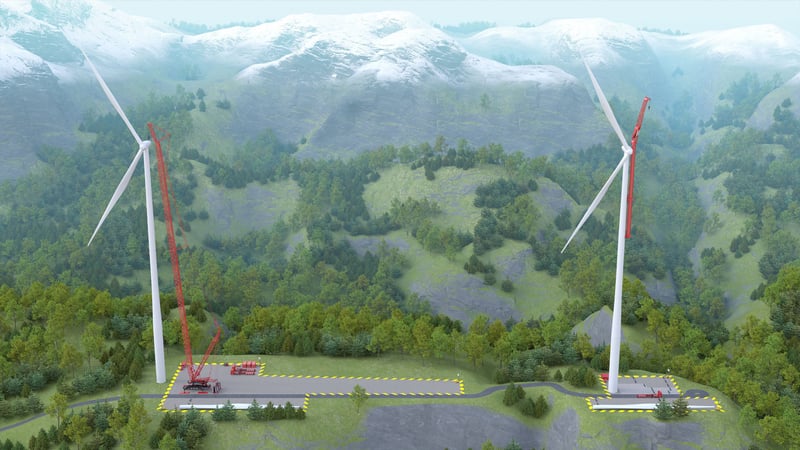
Compared to conventional tower cranes, the climbing crane will be much smaller and easier to get to site.
It is a simple idea, but a new crane design could soon be bringing major improvements to the way Vattenfall’s onshore wind farms are built.
The climbing crane concept uses the turbine tower instead of the ground for support as it adds more sections in stages, with no limit on how high it can go.
Although it is still on the drawing board, progress to date has been encouraging and a Vattenfall team from its Business Unit Onshore Wind is now working with experts from heavy lifting specialist Mammoet to take the development of their concept forward with hopes the new technology could be seen on sites within the next few years.
For Program Manager Jelmer Boukes and his team at Vattenfall, it would represent one of the biggest step-changes seen in wind farm construction for years, offering multiple benefits in terms of CO2 reduction, minimized impact on local communities and cost benefits.
“The climbing crane would be much smaller and easier to get to site, as well as to move to another location when it has completed a turbine,” Boukes says.
Jelmer Boukes adds that with less civil infrastructure, noise and disruption for the local community would be minimized.
Also, the climbing crane would be able to reach greater heights and operate in locations with up to 80 percent more wind, unlocking new complex and remote wind farm sites.
Significant CO2 savings possible
The reduction in transport activity around the building site due to the new crane, would reduce the carbon footprint of construction and impact on the local community.
There would also be direct benefits in the operation of the crane itself. Due to its much smaller engine and capacity requirement, the crane could be powered by electricity instead of fossil fuels.
Eva Julius-Philipp, Head of Environment and Sustainability Wind, welcomes the new concept:
“In total it is estimated that the new crane could significantly reduce transport and installation emissions during wind farm construction compared to standard methods. It will help us take another important step towards Vattenfall’s goal of net zero emissions by 2040 for our operations”, she says.
See also
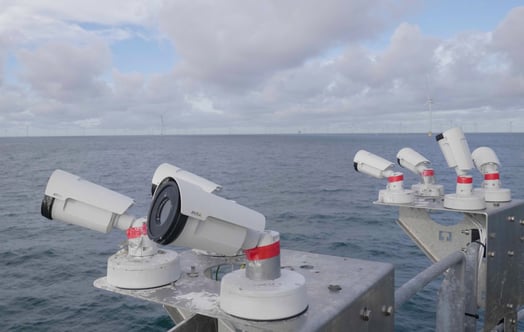
Thermal cameras shed new light on bird activity at sea
A thermal-camera and AI-system tested at Vattenfall’s Hollandse Kust Zuid offshore wind farm in the North Sea monitored bird movements around a turbine, day and night. As the technology work...
What it takes to build one of Europe’s largest offshore wind farms
In the German North Sea, the first visible signs of Nordlicht wind farm are beginning to emerge above the sea surface. By 2029, 112 wind turbines will make a strong contribution to the count...
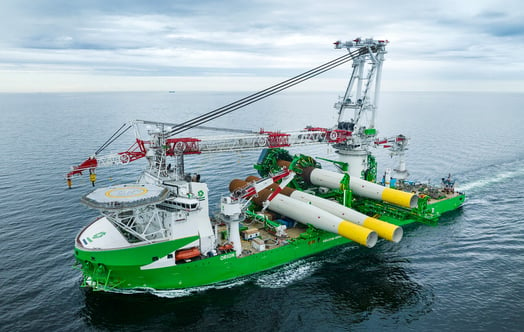
Vattenfall and Copenhagen Infrastructure Partners award DEME contract for foundation installation at Zeevonk offshore wind farm
Vattenfall and Copenhagen Infrastructure Partners (CIP), through their joint venture Zeevonk, have awarded a contract to DEME for the transport and installation of foundations for phase 1 of...