
- Largest fossil-free steel structure: A 21 m dam gate (120 tonnes) will be installed at Stornorrfors in 2028.
- Big climate impact: This HYBRIT technology could cut global CO₂ by 7%.
- High-quality breakthrough: HYBRIT’s fossil-free steel shows world-leading metallisation and durability.
In 2028, the world's largest object built entirely from fossil-free steel, a giant dam gate, will be installed at a hydroelectric power plant in northern Sweden. This demonstrates the possibilities of steel produced without CO2 emissions.

The new dam gate is designed to work until the year 2100 before it may need to be replaced. It’s quite breathtaking.
Sometimes concrete comparisons are needed to understand the scale of something. Vattenfall will make a dam gate, made of fossil-free steel ordered from HYBRIT-partner SSAB, for use at the Stornorrfors hydroelectric power plant. It will weigh 120 tonnes. That is equivalent to approximately 60 cars.
The 21-metre-high and 10-metre-wide dam gate is used to regulate the water flow at hydroelectric power plants, if not in production for example, and the goal is for it to be installed in 2028 and operational in 2029. Stefan Tyrbo is Vattenfall's project manager for the dam gate project.
"It's a complex process until then. The construction itself is, of course, extensive, but the logistics and installation will also require a lot of planning. With components this large, for example, special transport will probably be required, depending on how large the pieces are that we assemble in the workshop before transport.
Tyrbo mentions a number of other factors that will affect the process. The hatch must be able to withstand high hydraulic forces and requires careful calculations in terms of strength, corrosion protection and cavitation, for example. Manufacturing will also require great precision when it comes to welding and quality control.
The fact that the hydroelectric power plant in Stornorrfors, outside Umeå in north-eastern Sweden, was chosen is largely due to timing. When the new dam gate is ready, the current one will have been in use for over 70 years and will now need to be replaced due to wear and tear, as part of a planned maintenance.
“It’s not very common to replace dam gates at hydropower plants. When the new one is ready for installation, the current one has been in use for over 70 years. With the help of regular maintenance, inspections and spot interventions, the existing hatch still works well, but now it has reached an age where it is time for extensive renovation or replacement to meet modern requirements for dam safety and function. The new dam gate is designed to work until the year 2100 before it may need to be replaced. It’s quite breathtaking.”
Transition slowing down – for now
The dam gate, made of steel developed within the framework of the HYBRIT collaboration between Vattenfall, steel producer SSAB and mining company LKAB are intended to send positive signals to the industrial sector, showing what is already possible to do with fossil-free steel. According to this year's edition of the State of Climate Action report, development in this area has otherwise slowed down. Traditional production of steel is one of the biggest sources of carbon dioxide emissions. By means of HYBRIT technology, the coal in the steel-making process is replaced by hydrogen made from fossil-free electricity and water., thus eradicating carbon emissions. Potentially the method could decrease the world’s carbon emissions by around 7 per cent.
The order for the dam gate is in line with Vattenfall's strategy for the fossil-free transition and is a logical next step in the deepened collaboration between Vattenfall and SSAB from 2023.
“This applies not only to steel, but the entire industry's transition has lost momentum,” says Mikael Nordlander, Vattenfall's director of partnerships. “A few years ago, there was a lot of discussion about hydrogen projects and their role in the transition. Big plans were made. Now, very little has been realised and development is taking longer than many might have thought.”
SSAB's Thomas Hörnfeldt, Vice President Sustainability, believes that the European recession in key sectors for fossil-free steel, such as construction and automotive, has slowed down the acceleration, but he remains optimistic.
"Demand for fossil-free steel is increasing. I don't think anyone anywhere in the world doubts that trend. However, it is progressing a little slower now than two years ago. Or rather, it is progressing at different speeds in different places. This depends largely on the conditions.”
Six years of HYBRIT as preparation
In the case of Sweden and the HYBRIT project, there are enormous advantages in the fact that the electricity system is essentially fossil-free. This is a critical point for fossil-free steel, as large amounts of electricity are needed both to convert water into the hydrogen gas required for the process and to melt the sponge iron from which the steel is made.
Getting fossil-free steel production up and running is complicated and complex. Taking the HYBRIT project as an example, the process has evolved over a long period of time.
“It has taken us six years to build and put together all the pieces of the puzzle throughout the chain, from the iron ore in the mine to the finished steel,” explains Nordlander. “And that has been for industrial production on a fairly small scale. At our pilot plants, we have tested the various technologies required. We now know how to make iron ore pellets without using fossil fuels and we know how to produce sponge iron from iron ore using hydrogen instead of coal. This sponge iron we can smelt in order to and make steel.”
Today, the direct reduced sponge iron comes from the HYBRIT project’s pilot plant in Luleå, which SSAB in turn uses to produce fossil-free steel. Next step is the larger demonstration plant that LKAB is planning in Gällivare in northern Sweden.
“The iron we have produced is not only fossil-free, it is also very good,” says Hörnfeldt. “It has a high degree of metallisation. The fact that our fossil-free steel is of such high quality also means that the HYBRIT team know exactly how to design LKAB's plant. The fact that we first created a pilot plant differs from some other players who have chosen to develop on a full scale straight away, which takes time and can be uncertain, or who have not even got as far as creating a pilot plant. We are the first in the world in this respect.”
Register for our monthly newsletter THE EDIT
THE EDIT is Vattenfall's new monthly newsletter. Each issue highlights a new burning issue from the world of sustainable energy and fossil freedom.
Choice of material will become more important
Fossil-free steel requires patience. The transition of industry, in terms of steel but also cement, for example, requires cooperation, needs extensive investment and must also go hand in hand with an increase in the supply of electricity. Replacing large quantities of fossil fuels in industry might otherwise risk to shake up the global electricity market.
“Investments in industry must pay off for decades, so it must be able to rely on the electricity system to deliver fossil free and stable electricity far into the future,” explains Nordlander. "Sweden has a favourable starting point with an electricity system that is essentially completely fossil-free and robust. The basis of the system – nuclear power and hydropower – has already been largely paid for, which means that capital costs are low. Overall, this gives Sweden a very cost-effective and strong electricity system as a basis for the transition of industry. Vere few countries have this.”
Hörnfeldt envisions a future where demand for fossil-free steel will continue to increase. When, for example, the automotive industry looks at its carbon footprint, the focus is shifting from exhaust emissions, which are decreasing as the vehicle fleet becomes more electric, to the footprint of materials.
"The other major user of steel is the construction industry. The situation there is similar, in that the use of a new building does not have such a large climate footprint, thanks to low-energy and zero-energy buildings, but rather it is the materials that are the focus. Both conventional steel and cement face quite significant challenges in this regard. This means that demand for fossil-free steel will increase.”
See also
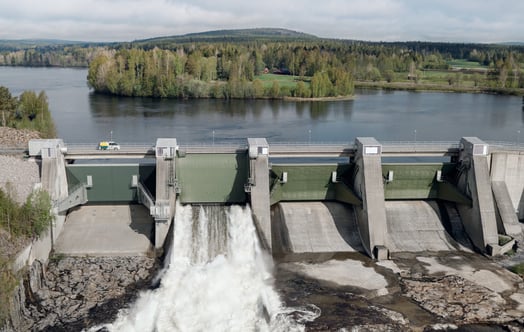
Vattenfall orders the world's first fossil-free steel dam gate from SSAB
Vattenfall and SSAB have signed a new agreement for the delivery of 120 tonnes of fossil-free steel for what will be the world's first fossil-free dam gate. The dam gate will be the largest ...
How algorithms are boosting pumped storage hydropower
Pumping water for hydro power production has been done for decades. But new algorithmic tools are now making this method even more valuable for grid stability.
How the snow that controls the spring flood is measured
When winter is at its peak, the Swedish mountain snowpack is measured to assess how much water the spring melt will release – a crucial task that shapres the annual cycle of hydropower.