
- A housing association is piloting V2G to cut emissions and strengthen energy resilience.
- Car batteries, bidirectional chargers and smart software work together to balance the grid.
- Europe’s growing EV fleet represents major untapped energy‑storage potential.
- Scaling V2G requires strong cross-sector collaboration.
Vehicle to grid is a process for using EV batteries for flexibility and balancing the grid. The potential is great, but where do we start? Well, maybe with a pilot project in a housing association in central Sweden.
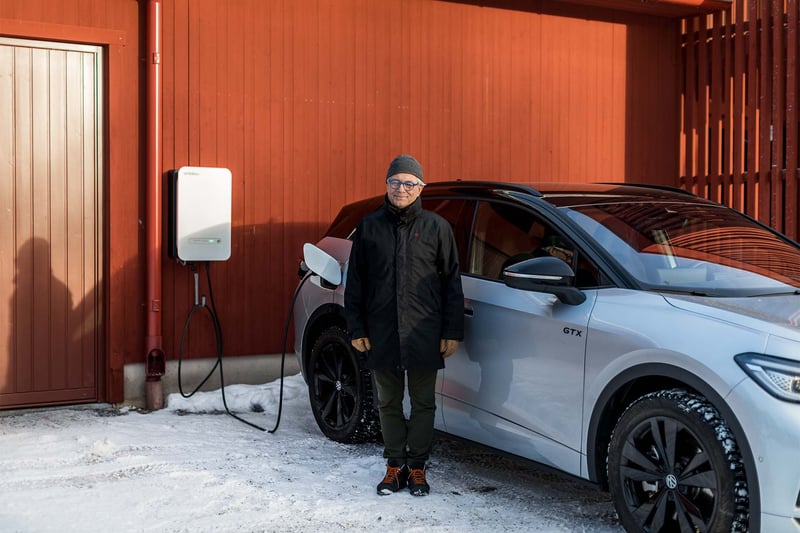
At first glance, the buildings in the Stenberg housing association look like fairly ordinary Swedish houses in traditional red painted wood. However, this first impression is soon contrasted by what is found in and around the houses. In fact, the area on the outskirts of Hudiksvall in central Sweden is the site of a pilot project that points the way for the energy supply of the future.
The housing association was created on the basis of the farm owned by the Boman family. Klas Boman founded the association and is one of the members of its board.
Here, the Boman family has invested to create the ‘living lab’ that comprises the association's eight homes. The goal is to have as low a carbon footprint as possible, something that is evident in everything from the choice of materials to how washed clothes are dried.
Part of the goal is for the association's cars to contribute to the electricity supply through vehicle-to-grid (V2G) technology. Parallel to this, the Energy Bank brand, of which Boman is the founder and one of the co-owners, has also been developed. Since its installation in autumn 2024, Energy Bank's software has been one of the components of the V2G system, which also includes eight cars from living lab partner Volkswagen and bidirectional charging stations.
Just over sixteen months later, Klas Boman sees overwhelming advantages with V2G, even though the licensing process to enable the use of cars for frequency support services took almost ten months.
”The practical experience of having access to these energy stores is very good and positive. With the capacity we have in the cars in this association, we could live for more than a day without having to draw on anything else. In these times, that is something very special.”
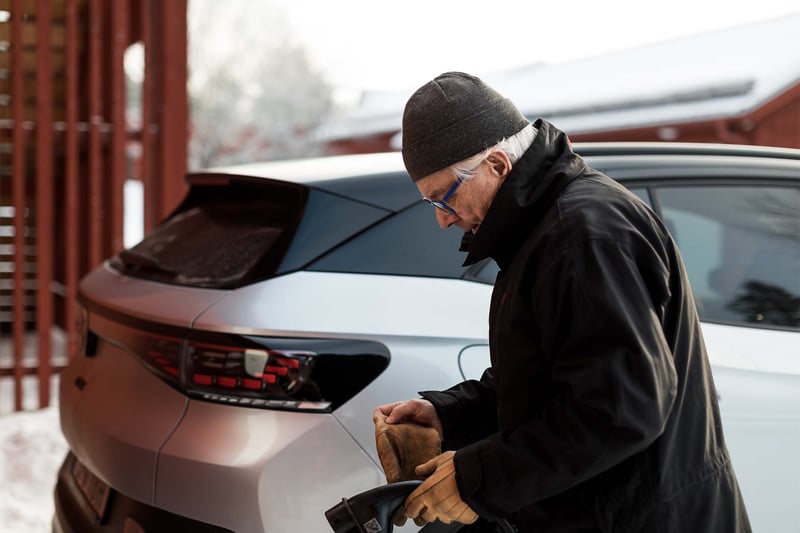
”With vehicle-to-grid, everyone can be a winner” says Klas Boman. ”That's what makes it so magical.”
Increasing storage capacity
V2G technology is based on four components. The customer's electric car battery is the resource that can be used for storing electricity. The battery is in turn connected to a bidirectional charging station, which can both supply the car's battery with energy and draw it out and use it. An energy management system is connected to the charging station, which optimises the use of both the battery's storage capacity and the electricity grid. An aggregator is also needed for this system to communicate with the electricity grid and electricity trading companies and see what the demand is.
Given that many electric cars are not on the road at all, or even for very many, hours of the day, there is plenty of time when car batteries could be put to other uses. There are almost 6 million battery-powered electric cars in the EU, 120 times more than just ten years ago. And the more electric cars that can be connected to the grid and controlled smartly, the greater the storage capacity.
“If you have a functioning system in place and ensure that cars are plugged into bidirectional charging stations as soon as they are stationary, the potential is enormous,” says Anna Larsson, Director Electromobility at Research Institutes of Sweden (RISE). “Think of car parks at large workplaces, commuter car parks, long-term car parks at airports and so on. Or think of larger vehicles, such as buses that stand still in depots at night.”
Stationary vs mobile batteries
The discussion surrounding the role of batteries in providing flexibility and storage opportunities has long focused on stationary batteries. Magnus Berg, R&D Portfolio Manager, Customer Products and Solutions, at Vattenfall, believes that mobile batteries, such as those in vehicles, should have a similar prominent position in the debate.
"Stationary batteries in Sweden currently have a capacity of just over one gigawatt. If all electric vehicles were connected to home chargers, that capacity would be roughly the same today. But both of these volumes are growing. One is already used today as a flexible resource in the electricity market, while the other is hardly used at all so far.”
The reason for this difference is that V2G technology is lagging behind somewhat.
“When car manufacturers constructed vehicles five or ten years ago, no one prepared the cars to be able to discharge power to a house or the electricity grid,” explains Berg. “As a result, one-way electric car chargers were manufactured. Their function was to charge the car, nothing else. To use V2G, you need a car that is prepared for two-way charging, which is the case for more and more cars today. However, you also need a two-way charger, which is still relatively uncommon.”
The possibility of local balance
On the other hand, if everything is in place, there is great potential for car batteries to be used, for example, as support services for frequency regulation, which could generate income for individual car owners. Another use could be to mitigate a prolonged power outage.
”Think of something as simple as the refrigerators and freezers in grocery stores,” says Boman. ”If every store had a number of double-charging posts, they could continue to operate without the food thawing or heating up if the power was out for an extended period. The retailer might even have been willing to pay a small fee to each car owner who volunteered. There are many positive aspects to V2G and very few negative ones.”
Anna Larsson also highlights local solutions:
”Balancing the electricity grid is important, but it is also possible to balance locally and use the energy stored in car batteries right there and then. It may even be more efficient to work that way.”
Cooperation is key
The potential of V2G is also underscored by a general increase in demand. Approximately 40 per cent of the EU's electricity production comes from renewable energy sources, and that figure is set to rise by 2030. Part of that increase will be driven by weather-dependent sources such as solar and wind power, which means that flexibility in the electricity grid will become increasingly important. At the same time, electricity consumption is also predicted to increase significantly. According to the Swedish Energy Agency, Sweden's electricity demand is expected to double by 2035, to take one example.
A steadily growing fleet of electric cars, and the potential for vehicle-to-grid solutions, could mean that at least part of the demand is met. To achieve this, cooperation is needed, says Anna Larsson.
”The way forward is to start working cross-functionally. Energy companies need to engage in communication and collaborations with vehicle and electricity grid companies, as well as various other social actors. If we strengthen that dialogue and show that it works in different cases of users, I believe it can grow from there step by step.”
As with many other things, part of the potential lies in moving from smaller local pilot projects such as Stenberg to creating larger systems. That is why Energy Bank, together with Vattenfall, will be running a larger pilot project over the next two years, which will include 200 bidirectional chargers and at least as many electric Volkswagens.
”With vehicle-to-grid, everyone can be a winner” says Klas Boman. ”That's what makes it so magical.”
See also
How algorithms are boosting pumped storage hydropower
Pumping water for hydro power production has been done for decades. But new algorithmic tools are now making this method even more valuable for grid stability.

How the snow that controls the spring flood is measured
When winter is at its peak, the Swedish mountain snowpack is measured to assess how much water the spring melt will release – a crucial task that shapres the annual cycle of hydropower.
Hydropower at Vattenfall’s R&D centre - where tradition meets innovation
Hydropower has been a reliable, stable and renewable part of the energy system since the late 19th century. However, this does not mean that it is fully developed. The Edit visited Vattenfal...