
In its new German solar park Vattenfall is using recycled, low-emission, steel for the mounting structures, offering 67 per cent CO2 reduction compared to conventional steel.
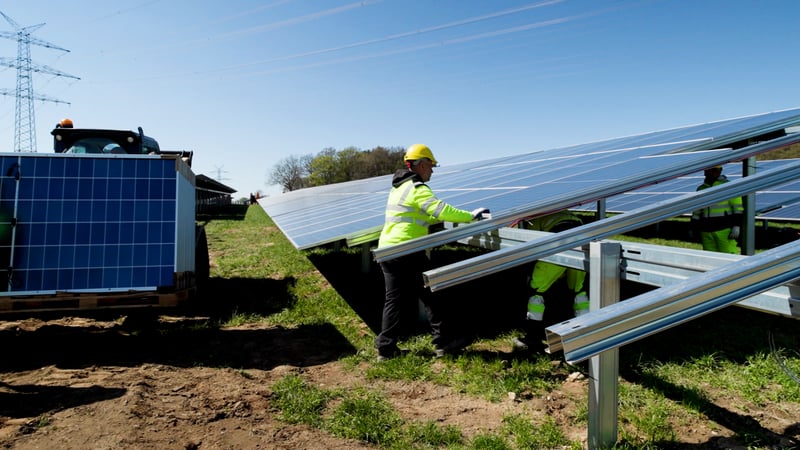
Using low-emission steel for the substructures in the Juliusburg/Krukow solar farm reduces the carbon footprint.
Solar power already today makes a significant contribution to fossil free power production in Germany. But while production of solar power is fossil free, there is still work to do to reduce carbon emissions from the construction phase. Using lower-emission PV modules is an important consideration in Vattenfall’s procurement. Another way of reducing the carbon footprint is to use low-emission steel for the substructures when possible.
A recent example is the 80 megawatt solar park project Juliusburg/Krukow, 45 minutes east of Hamburg. Here Vattenfall has decided to use low-emission steel for the solar panel substructures on the Krukow section of the site.
Reduced carbon footprint
The structures are built with recycled steel produced by Swedish steel producer SSAB and using fossil free electricity in the manufacturing process.
“We started by looking at the technical features of the SSAB Zero steel and concluded that it was just as good as traditional steel when it comes to strength and quality. Also, our calculations showed that the financial impact was reasonable in respect to the sustainability gains we would get,” says Lasse Fast Jensen, Head of Sustainable Design & Sustainable Procurement at Vattenfall’s Business Area Wind.
A place in the sun for insects, birds and bats
Besides using low emission materials, Vattenfall is also introducing several measures to strengthen biodiversity in the Juliusburg/Krukow solar park. Beetle banks, ponds, deadwood, stone piles, open ground, nesting boxes and native hedges will provide food and habitats for insects, birds, bats and other wildlife. Staged mowing and grazing help preserve refuges, while scientific monitoring tracks the results.
Claus Wattendrup, Head of Solar & Batteries at Vattenfall, comments:
“The electricity generated from this solar farm will help reduce Germany’s dependence on imported fossil fuels. But for us, fossil freedom does not start with renewable electricity generation – it starts right at the beginning of the supply chain. That is why we are pleased to take this pioneering step together with our partner SSAB, using low emission steel for the substructures. By leading the way as a company, we support the long-term societal goal of becoming fossil free.”
High quality steel
The Juliusburg /Krukow solar park is able to generate up to approximately 80 GWh of fossil-free solar electricity annually. The solar park was commissioned in the summer 2026.
“This project shows that when clean energy generation such as solar power is combined with lowemission materials, the climate footprint is reduced across the entire value chain. With SSAB Zero, we deliver decarbonised steel with the same performance and quality as conventional steel. Vattenfall’s decision to use it in this solar park is an important example of how ambitious customers can help scale solutions that reduce emissions and build demand for cleaner materials," says Matts Nilsson, Vice President & Head of Sales, SSAB Europe.
Vattenfall is also using low emission steel in the construction of its wind farms for instance in the Clashindarroch II onshore wind farm in the UK and the Nordlicht offshore wind cluster off the German North Sea coast.
Read more about our attitude There’s a way
Read more about how Vattenfall works to reduce emissions by choosing climate smart materials
Facts about Juliusburg/Krukow solar park:
- The Juliusburg/Krukow solar park is in the district of Herzogtum Lauenburg in the German state of Schleswig-Holstein, close to the municipalities of Juliusburg and Krukow from which it takes its name.
- With a nominal capacity of 80 megawatt-peak (MWp), the solar park will be able to generate up to approximately 80 GWh of fossil-free solar electricity per year.
- The total site covers an area of approximately 74 hectares.
- Vattenfall is using low-emission steel from its Swedish partner SSAB for the substructures of the solar modules (PV mounting systems) on the Krukow section of the site. Compared with the use of conventional steel, this reduces CO2 emissions in the construction and supply chain by 67 percent.
See also
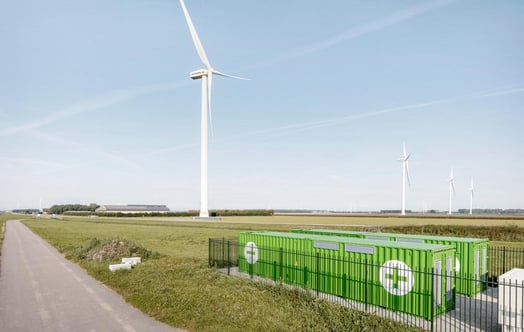
Vattenfall’s battery portfolio now exceeds 1.2 GW supporting a more flexible and affordable energy system
Vattenfall’s battery portfolio has grown rapidly to exceed 1.2 GW in power, following the final investment decision for its Brunsbüttel battery in Germany and a recent agreement with Royal V...
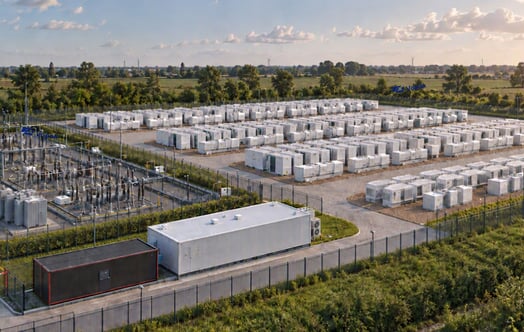
Vattenfall and Royal Vopak team up to further integrate renewable energy into the Dutch power system
Vattenfall has signed a tolling agreement with Royal Vopak (‘Vopak’) for a portion of the planned battery energy storage system near Meeden in the province of Groningen, the Netherlands.
Why electrification cannot wait
When fossil-fuel prices rise, households and businesses feel the impact. Switching to fossil-free electricity can reduce that exposure. Europe worked hard to increase fossil-free electricity...