
Smart algorithms for better fish migration
Is it a fish? Which fish is it? How is it doing? Vattenfall will soon be able to answer these questions immediately by programming smart self-learning algorithms. The aim is to use this technology to improve biodiversity in watercourses.
Over the next 20 years, Sweden's hydropower plants - over 2,000 of them - are to be provided with modern environmental conditions. Most - around 90 per cent - are quite small, with an installed capacity of less than 10 MW.
In some of these the possibility that migrating fish have to pass upstream and downstream of the plant will be important.
"It must be possible to prove that the existing fish passage really works effectively," explains Patrik Andreasson, specialist at the Älvkarleby laboratory.
AI - artificial intelligence trained to recognise different characteristics
Vattenfall's research and development department in Älvkarleby has therefore, together with Vattenfall Vattenkraft, started a project to make this process more efficient using artificial intelligence.
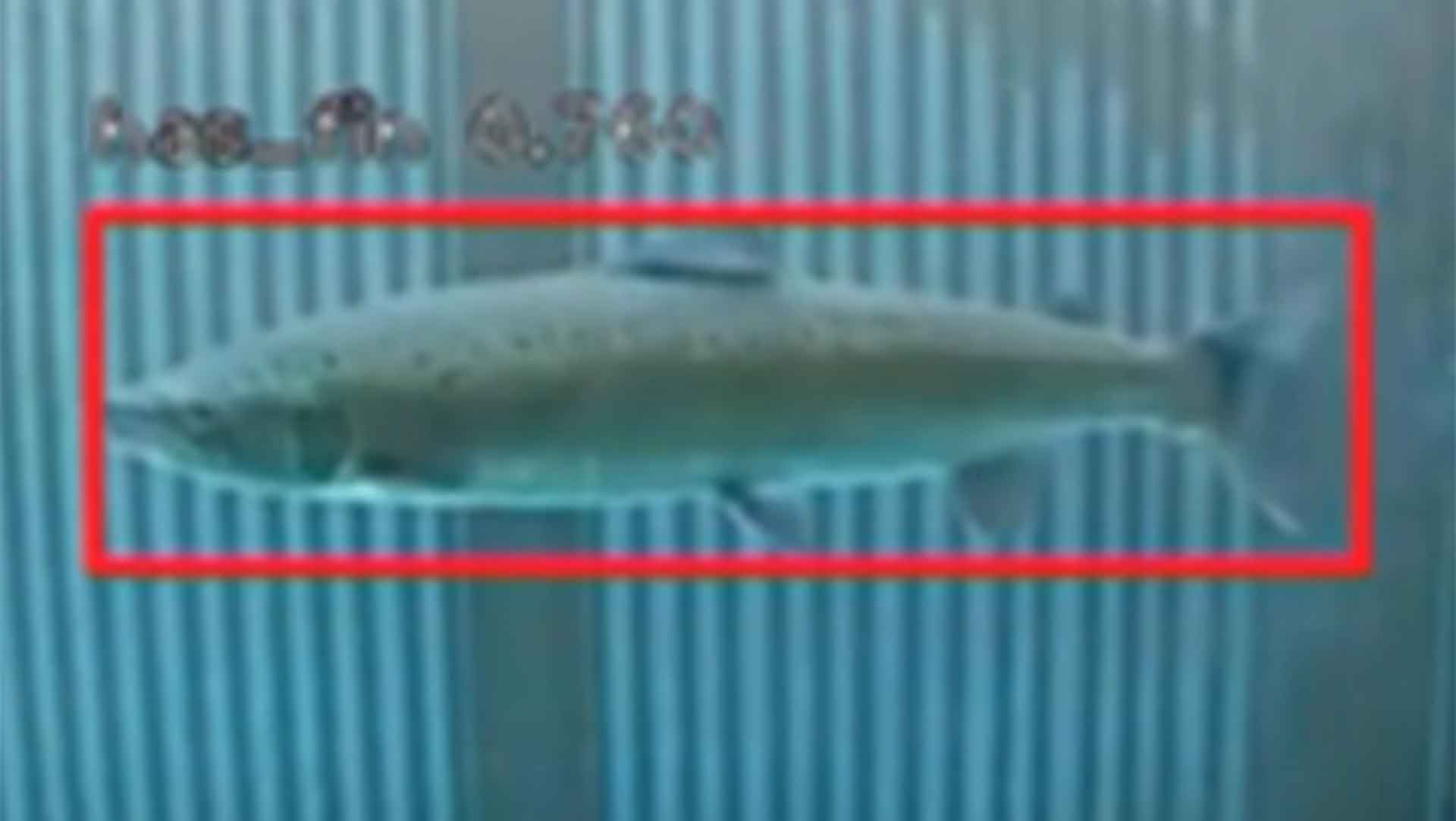
"We're using a variant of AI where the programme is trained on a large quantity of visual material which directly analyses images of migrating fish filmed underwater to recognise different characteristics to a ready-made so-called algorithm. In the first phase of the project, the algorithm will be trained on characteristics such as fish or not, salmon or not, farmed or wild salmon, fungal infection or not. In phase two, the algorithm will also be trained to distinguish between salmon and trout, to determine the size of the fish and possibly also to include more species and identify returning individuals," says Andreasson.
Video player requires marketing cookies.
To view this content please click here to allow marketing cookies.
Stornorrfors power station chosen as pilot
Vattenfall has just over 100 hydro power plants, most of them in Sweden and most of larger size. Stornorrfors power station, the hydro power plant with the highest generation capacity in Sweden, has been chosen as the pilot for the algorithm.
"At Stornorrfors, we've built one of Europe's most modern fish ladders for migration up and down the Vindelälv, one of Sweden's national rivers. The project forms part of Vattenfall's investment in biodiversity, and in order for the knowledge to benefit more people the algorithm will be open for others to use and build on," says Andreasson, and continues:
"As a further stimulus to this project, a collaboration has been initiated for a continuation in the form of a large-scale research application together with leading researchers in machine learning (AI) and fish biology at Luleå University of Technology and the Swedish University of Agricultural Sciences," says Andersson.
See also
Huge road and tunnel project in the UK aims to reshape construction for the future
Construction is one of the hardest sectors to decarbonise. But in the UK, a major infrastructure project aims to reach carbon neutral by using electric machinery and low‑emission materials.
Rethinking cement: cutting emissions at the source
Cement is one of the world’s most widely used construction materials – but also one of the largest sources of emissions. That insight marked the starting point for Swedish company Cemvision,...
IQIP, EnBW and Vattenfall announce full-scale offshore monopile installation using EQ‑Piling technology
IQIP, EnBW and Vattenfall: Offshore installation of a complete monopile using EQ-Piling technology