
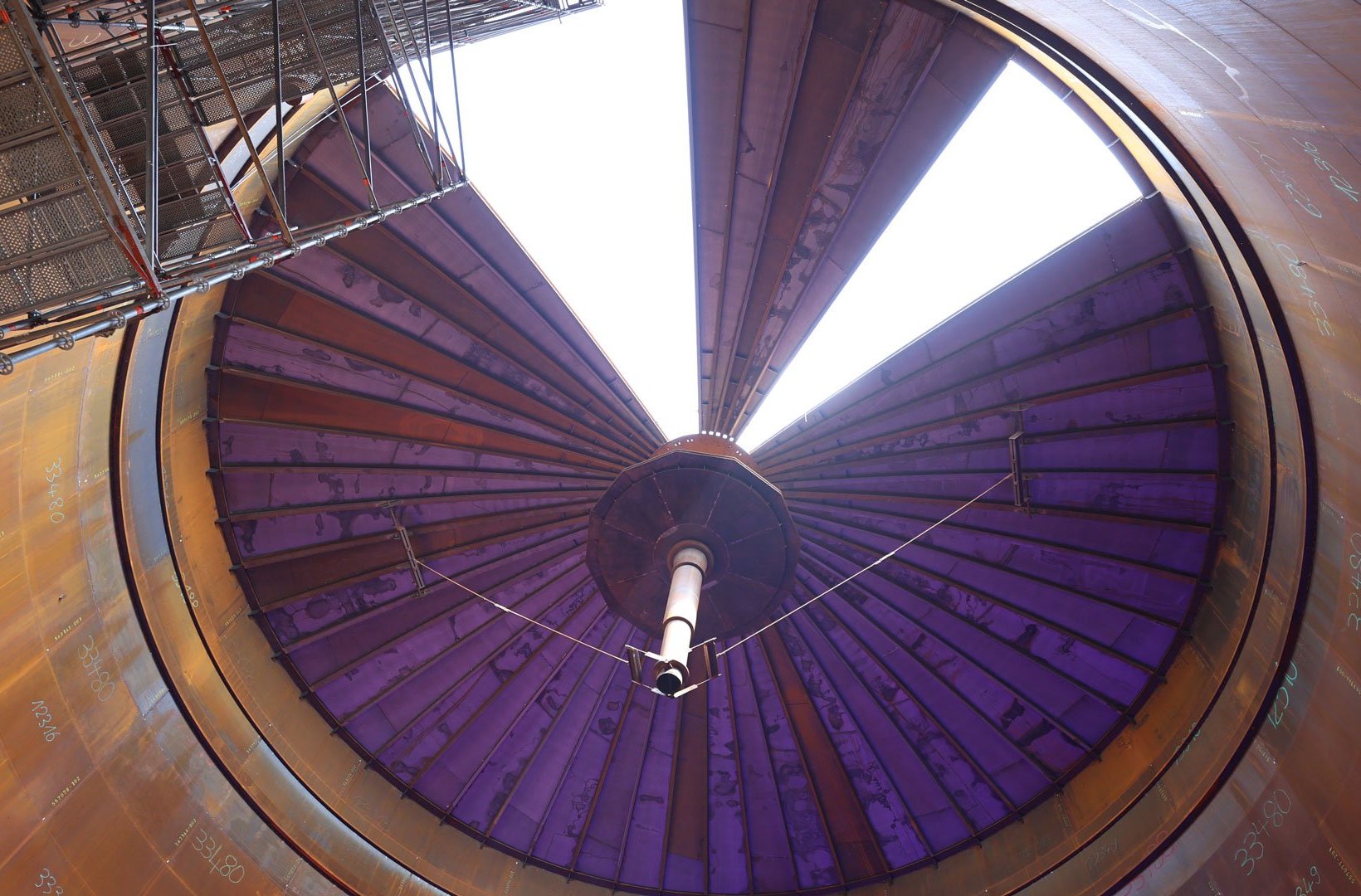
Germany's largest heat accumulator is expected to be commissioned at the start of next year. The heat storage is located on Vattenfall's site at the Reuter West CHP plant in Berlin and is now being filled with a water volume of around 350,000 bathtubs.
At 45 metres high, with a diameter of 43 metres and a capacity of 56 million litres, Germany's largest heat accumulator will store district heating water at a temperature of 98 degrees Celsius and therefore play a significant role in driving forward the heat and energy transition in Berlin and contribute to energy security in Germany. Together with the power-to-heat plant – which is the largest in Europe – adjacent to the power plant site, the heat storage will help to increase the use of surplus renewable energy from the grid.
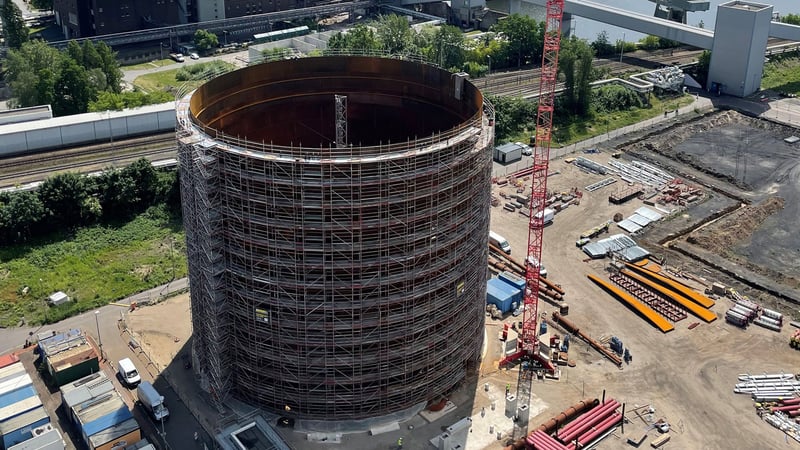
Bird's eye view of the heat accumulator tank
The heat accumulator on Vattenfall's site at the Reuter West CHP plant in Berlin is expected to be commissioned at the start of next year. It should take up to two months to fill the impressive hot water tank with a volume equivalent to around 350,000 bathtubs. The CEOs of Vattenfall Wärme Berlin AG, Tanja Wielgoß, and the Berlin environmental senator, Bettina Jarasch, assessed the situation at the site on 30 June before the heat accumulator was due to be filled for the first time.
Individual solutions are not enough
"The heat storage shows that the future of heat supply doesn't lie in individual solutions, but in overall systems", stresses Wielgoß. "Because it ensures that the many building blocks of the future Berlin heating system, both large and small, complement each other perfectly." The heat accumulator is located on the power plant site directly next to the power-to-heat plant, which converts surplus wind or solar energy into heat on site. In the future, it will be possible to store this heat temporarily in the hot water tank – before it is supplied to the municipal heating grid. "With a thermal output of 200 megawatts, the accumulator can supply heat for 13 hours – even in very cold weather," says Wielgoß. Other local waste heat sources – such as wastewater and thermal waste – can also be connected to the accumulator with flexibility as required.
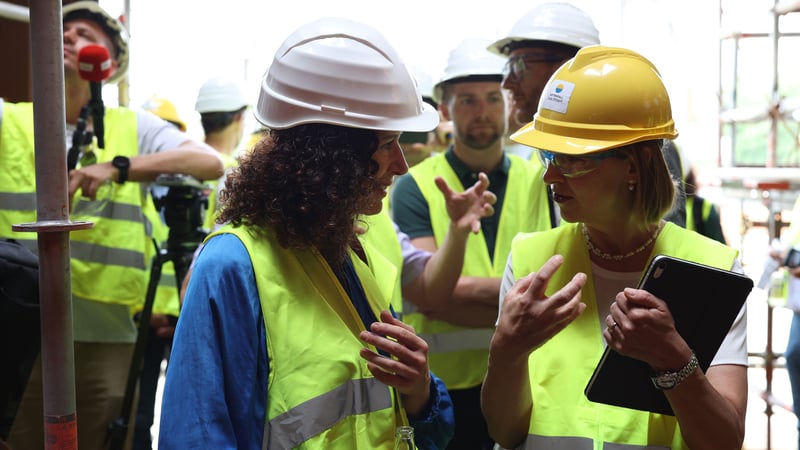
Tanja Wielgoß in conversation with Berlin’s environment senator Bettina Jarasch
Together with Berlin's environmental senator Bettina Jarasch, Vattenfall Wärme Berlin's Chair of the Executive Board is seizing the perhaps unique opportunity to look at Germany's largest heat accumulator from the inside before it is filled with water in the coming months and then commissioned. Wielgoß emphasises: "The plant is an important step on the path to more flexibility in Berlin's heat supply and at the same time making it more climate-friendly, independent and safer."
The goal – to be climate neutral by 2040
Vattenfall Wärme Berlin AG supplies municipal heating to around one third of the buildings in Berlin. The owners and residents of these buildings have outsourced one of the most pressing challenges of our time: they no longer have to worry about achieving CO2-free heating for apartments and showers. Vattenfall's goal is to be climate neutral by 2040 – and the decarbonisation of the municipal heating supply is key in reaching this goal.
See also
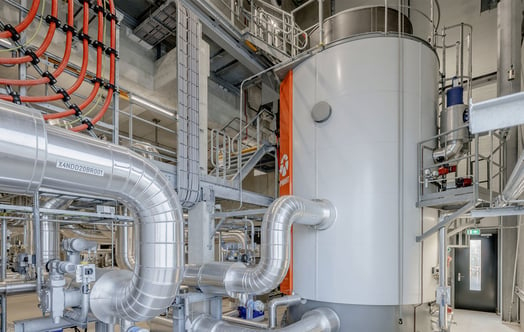
Giant water heater makes district heating more flexible
In Diemen, the Netherlands, Vattenfall converts renewable electricity into heat for thousands of households.
Going underground – Netherlands geothermal heat transition
Geothermal heat and energy is a somewhat untapped source in many parts of the world. For the Netherlands drilling for, and using, heat from the earths subsurface could both relieve the grid ...
Heatwaves boost interest in heat pumps across Europe
Heat pumps are best known as an energy-efficient way to heat homes. But as heatwaves become more frequent, many homeowners are discovering that the technology can also help keep homes cool.