
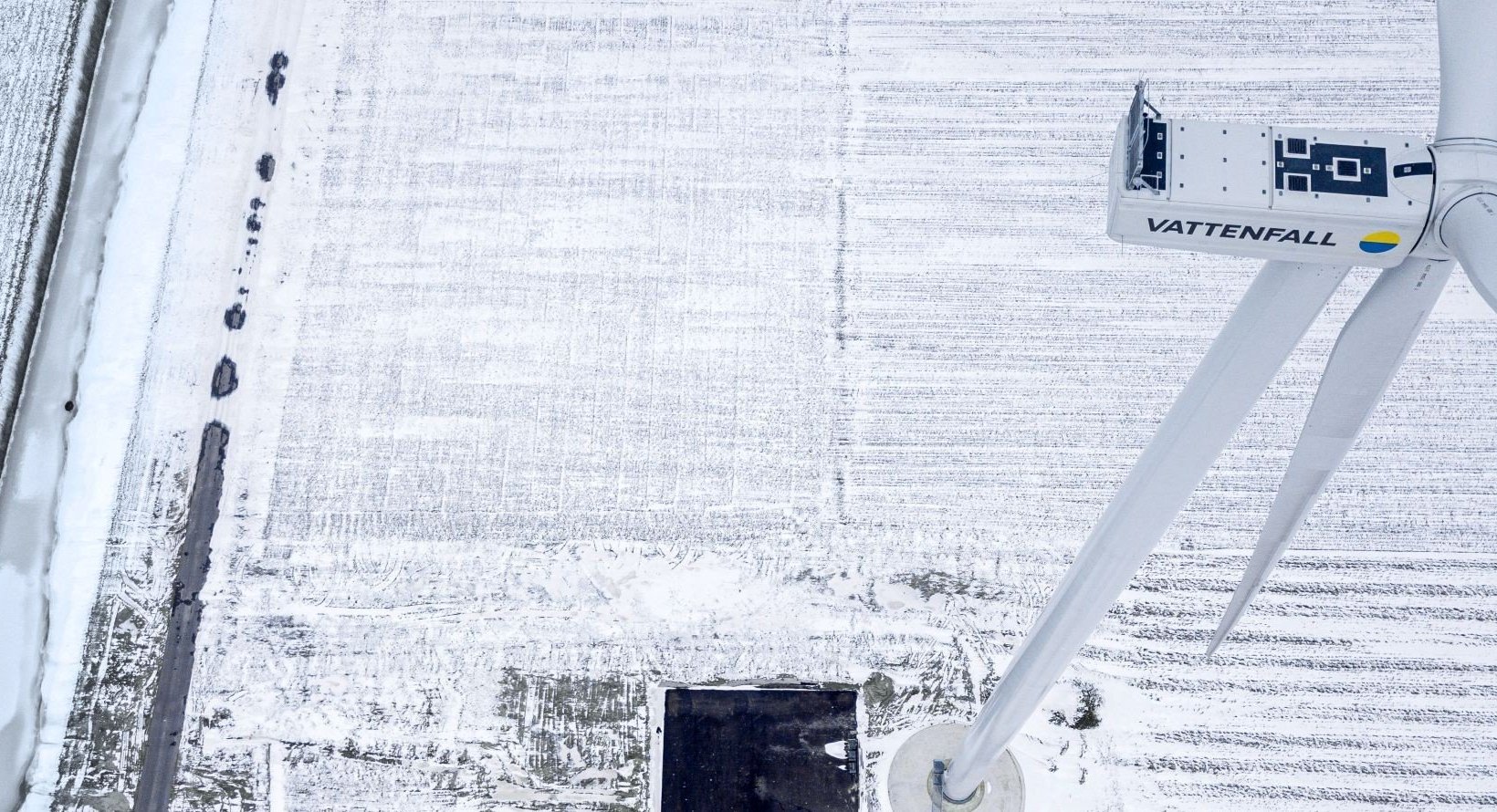
- Modern wind power provides essential grid‑stabilising services,
- This is countering outdated views that it cannot support system balance.
- Turbines can quickly up‑ or down‑regulate production, depending on market needs and wind conditions.
- Integration of power electronics and batteries increase the power system value of wind farms even more.
Technological developments are challenging old perceptions of wind power generation. Today, wind power is becoming increasingly important in delivering ancillary services that stabilise the electricity grid.
A stable and modern electricity system needs flexibility in the system that can counteract imbalances that arise between power supply and demand. In the discussion about how different power sources can contribute, the view is sometimes put forward that wind power does not have such capabilities. But this is a serious misconception, says Vattenfall's experts; in fact, the importance of wind power in delivering system services is steadily growing:
"There is a perception in some quarters, based on what it was like perhaps 15 years ago, that wind power generation does not contribute to stabilising the electricity grid, or even impairs stability. But technological developments have come a long way and today wind power is playing an increasingly important role. We deliver some of the services in accordance with the requirements of the grid owners, while other services are offered on the market for ancillary services," says Fredrik Bjarnegård, Lead Asset Manager at Onshore Wind at Vattenfall.
Output can be reduced or increased
One hot issue is the possibility of utilising wind power for active power regulation, thus helping transmission system operators to achieve balance in the power system. Wind turbine blades are adjustable and can be turned away from the wind - or towards it, using motors in the hub. In this way, a turbine can be switched from full production to no production, or vice versa.
“We always produce at full capacity when it's profitable. This means we of course have the option to curtail the production and down-regulate, which we do regularly when there is a market demand.”
There are also some opportunities to increase production. This is particularly true if the turbines are stopped on beforehand even though it is windy.
“This happens when the price of electricity is very low and does not cover the operating costs, or when the price of flex services is higher than the spot price on the electricity market. Because even if the wind itself is free, we have operational costs, including for using the electricity grids. When this happens our power plants are put into standby mode even though the wind is blowing, and it means we have the possibility to up-regulate instead. We can start up in a few minutes when the market needs more power as we just need to turn the turbine blades a little. This type of up-regulation is done several times per week," he says.
Direct control ensures fast response
As the need for flexibility is largely driven by the addition of more weather-dependent power generation to the system, the ability to react quickly to the market has become increasingly important. Also, the EU has now introduced quarterly metering of electricity, where the price is set every 15 minutes instead of hourly.
Today, about ten of Vattenfall's wind power plants in Sweden and Denmark, are controlled directly from the trading department, which in principle means a direct link between wind power generation and the flexibility markets.
Technically, wind power can supply all the products traded on the Swedish market.
The Swedish market for flexibility services is run by the Swedish transmission system operator Svenska kraftnät. Here, players can bid on ‘flexibility products’ in the form of various services for power balancing and frequency regulation for both up and down regulation of production. Markus Bäck is responsible for Vattenfall’s Intraday Optimisation and Dispatch in the Nordic region:
“Markets for flex services have existed for a long time, but have grown in recent years both through new products from Svenska kraftnät and by increased volumes procured for some existing services. In recent years, price levels for ancillary services have also increased which has made the flex market more attractive also for wind power," he says.
One of the strengths of wind power is that production can be adjusted so quickly:
“Technically, wind power can supply all the products traded on the Swedish market, while for instance hydropowerwhich is slightly slower to regulate, has difficulties with the fastest products. The challenge for wind power is instead that we need wind in the first place in order to enable regulating power output up or down, and it’s not always windy," says Markus Bäck.
Power electronics and batteries provide more capabilities
Modern wind farms can also do much more than accelerate and brake the turbines. A reason is that power electronics have become more powerful and cheaper. Power electronics help wind farms provide a range of stabilising system services and enable wind power to deliver exactly the power quality the grid needs. These include services to keep the grid frequency stable at 50 hertz, or to balance reactive power that occurs in an electricity system. Reactive power, also known as wattless power, reduces the transmission capacity of electricity networks.
In addition, many wind farms are combined with large batteries, which further increases the possibilities, for example in terms of the fastest flexibility service, FFR, Fast Frequency Reserve, also known as synthetic inertia*.
“It is clear that wind power is playing an increasingly important role in providing services to the electricity system and this will continue. For us as a wind power operator, this also means that ancillary services have gone from being a marginal part of the business to now making a good contribution to revenues," says Fredrik Bjarnegård.
*) Inertia normally refers to the stored kinetic energy in large rotating parts, such as turbines, in hydro and nuclear power plants. Inertia is an important part of a stable energy system, but currently these power sources do not receive compensation for this system service.

Blakliden-Fäbodberget wind farm in northern Sweden delivers grid services to the Swedish TSO.
See also
How algorithms are boosting pumped storage hydropower
Pumping water for hydro power production has been done for decades. But new algorithmic tools are now making this method even more valuable for grid stability.
How the snow that controls the spring flood is measured
When winter is at its peak, the Swedish mountain snowpack is measured to assess how much water the spring melt will release – a crucial task that shapres the annual cycle of hydropower.
Hydropower at Vattenfall’s R&D centre - where tradition meets innovation
Hydropower has been a reliable, stable and renewable part of the energy system since the late 19th century. However, this does not mean that it is fully developed. The Edit visited Vattenfal...