
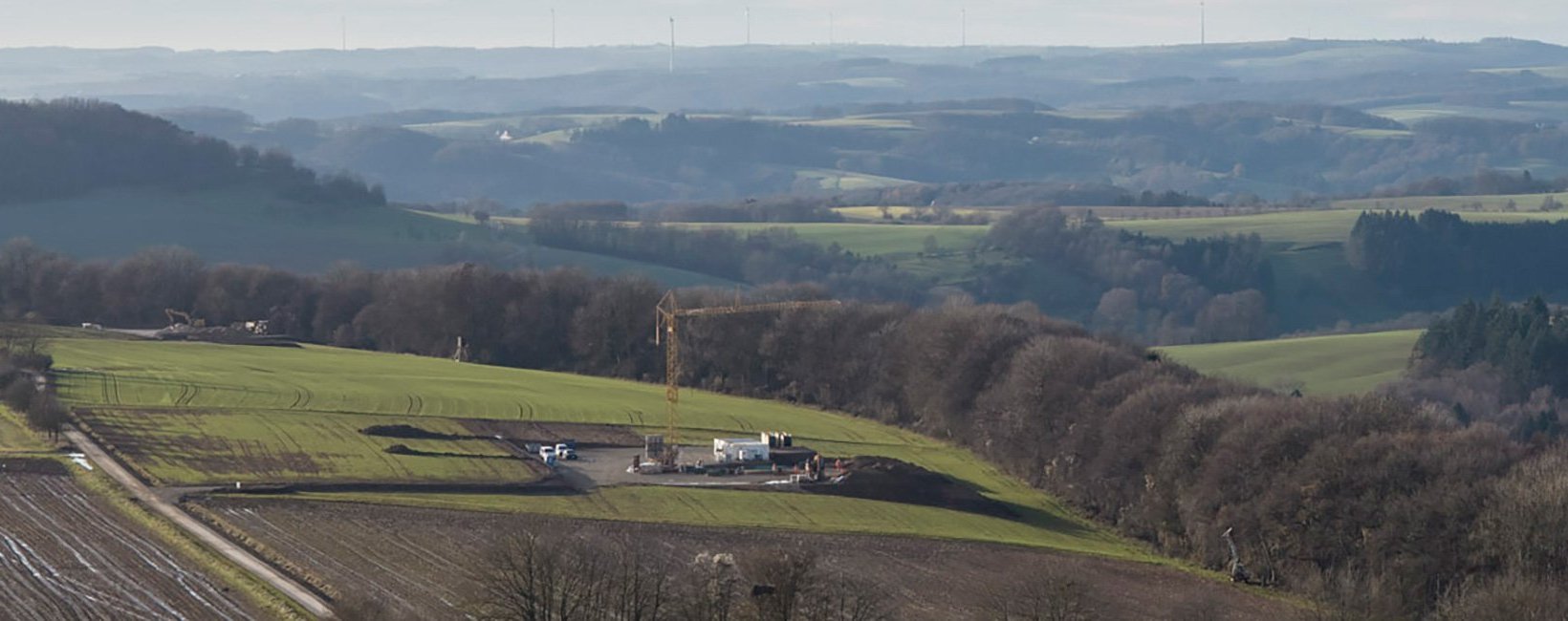
Hybrid park Hommerdingen-Biesdorf is Vattenfall’s first combination of wind and PV in Germany and sets standards for modern, cost-efficient, and grid-friendly energy generation.
Producing smarter electricity with renewable energies: Vattenfall is now starting construction of the hybrid power plant Hommerdingen-Biesdorf. For the first time in Germany, the company is combining electricity generation from wind and solar under one roof and implementing a concept that Vattenfall has already been successfully operating in the Netherlands for several years. It is another important step for the company to support the transition to fossil-free energy and thereby advance society.
The hybrid power plant Hommerdingen-Biesdorf consists of four wind turbines manufactured by Enercon with a total rated output of 17 megawatts (MW), and more than 12,000 solar modules with a rated output of 7.6 MWp. It is being built across the municipal areas of Hommerdingen (wind park) and Biesdorf (solar), both part of the Südeifel municipality near the Luxembourg border. According to current planning, the commissioning of the plant is scheduled for autumn 2026.
Hybrid parks – more generation with less grid load
With the Hommerdingen-Biesdorf project, Vattenfall is pursuing the approach of not connecting the solar park separately but linking it to the distribution grid through the wind park of the local operator Westnetz. Technically, the solar park is thus treated as an additional wind turbine, requiring only one grid connection for the entire installation — an approach to which Westnetz agreed.
Philipp Heucke, Head of Onshore Wind Development at Vattenfall in Germany, says: “We are pleased to implement the combination of wind and solar together with our local grid partner Westnetz. The complementary generation profiles of wind and solar relieve the distribution grid compared to individual generation technologies. This leads to more efficient use of the grid infrastructure and reduces the risk of grid overload. In addition, the costs for the grid connection decrease significantly compared to stand‑alone plants. This lowers the cost of renewable electricity and ultimately benefits customers.”
Hybrid parks at Vattenfall
Hybrid parks combine renewable generation facilities such as wind and solar, but also generation combined with battery storage. In the Netherlands, Vattenfall operates the Haringvliet project — a full hybrid power plant combining wind, solar and an additional battery storage system. In Germany, Vattenfall plans to add battery storage systems primarily to solar parks, depending on local conditions.
See also
Thermal cameras shed new light on bird activity at sea
A thermal-camera and AI-system tested at Vattenfall’s Hollandse Kust Zuid offshore wind farm in the North Sea monitored bird movements around a turbine, day and night. As the technology work...
What it takes to build one of Europe’s largest offshore wind farms
In the German North Sea, the first visible signs of Nordlicht wind farm are beginning to emerge above the sea surface. By 2029, 112 wind turbines will make a strong contribution to the count...
Vattenfall batteries secure fossil-free electricity for Way Out West festival
The Way Out West festival in Gothenburg is one of the biggest in Northern Europe. This year the music festival it is powered by fossil-free electricity and battery storages from Vattenfall.