
From theory to practice – how circularity could permeate companies’ value chains
Most companies recognise the importance of circularity, but turning ambition into action remains a challenge. What does it take to move from ambition to action – and make circularity part of everyday business?
Ten ways of moving towards circularity
Top management
- Include circularity in core KPIs
- Tie financing to circular results
Business innovation and R&D
- Develop circular product design
- Use data and new technology for capturing value
Value network collaborations
- Co-design attractive circular offerings
- Initiate strategic circular pilots
Internal operations
- Set clear governance and ownership
- Adopt circular tools, standards & checklists
Policy and market
- Promote circularity in public affairs
- Participate in stakeholder groups
Check out the Circular changemaker's guide for more mechanisms
Circularity has become a puzzle that many companies struggle to solve. There is no lack of willingness or tools, but progress remains slow.
“86 per cent of Nordic companies have incorporated the circular economy into their core business strategies, but only a few have started implementing circular processes in their operations,” says Sofia Sundström, CEO of Cradlenet, a network helping companies transition to circularity.
In a report Cradlenet carried out the most common barriers mentioned by the interviewed CEOs were “uncertain business case”, being “stuck in current business model” and “low demand”, but there’s a bigger picture. According to Sofia, more company leadership need to understand that having a circular offering does not make them a circular company.
“Having a circular offering does not make a company circular. The entire business – from strategy and the value chain to internal structures and processes, as well as external communications – needs to be grounded in circular principles, measure circularity and work towards circular outcomes.”
To help companies move from words to action, Cradlenet and the eight companies in the Nordic Transition Group for Corporate Circular Transition, including Vattenfall, have created The Circular Changemaker’s Guide.
From linear to circular
For Sofia Sundström and Annemarie Kerkhof, a Strategic Environmental Advisor at Vattenfall, circularity begins with understanding the opportunities of circularity and raising awareness. Annemarie Kerkhof describes how Vattenfall explores reuse of components, from cables to turbines.
But circularity goes beyond reuse. It also involves working with suppliers, reducing material consumption, developing new business models and raising awareness throughout the organisation.
“The challenge is to do things differently from how they have been done before. Colleagues may be used to a certain way of working, and it requires effort to change that. As a first step, the benefits of a changed way of working should be clear,” she says.
Start where it makes most sense
While change might be hard sometimes, it’s got to start somewhere. A company may want to focus on strategic measures such as framing circularity as business-critical, or more operational initiatives such as designing incentives for circularity and sharing risks, costs and value creation.
"The ’mechanisms' that we introduce in the guide exist on every business level. You can start at any point depending on what is most suitable for your company right now: at the top management level, at the operational level or with external communication and public affairs. The guide does not provide a set of activities to be applied in a sequential order, but rather each mechanism is meant to become an integrated and systemic way of working and all mechanisms are meant to reinforce each other,” Sofia Sundström adds.
Collaboration in the value chain is the key to circularity
Circularity of course also goes beyond the own organisation – most companies are part of a value chain. That means collaborating with suppliers can create an environment where you can help each other. Annemarie Kerkhof takes the example of Vattenfall’s solar park Juliusburg-Krukow in Germany, where recycled steel from longtime partner SSAB is being used to create the solar panels’ substructures. Steel is one of the seven key materials Vattenfall’s circularity-work focuses on, together with concrete, aluminium, copper, polymers, lithium and rare earth materials.
”You need to work together with players in the whole value chain. That means suppliers as well as customers and that's challenging. You need to have dialogues and then make changes step by step to become more circular. So you need to involve many stakeholders to get results,” Annemarie Kerkhof notes.
Most production has traditionally followed a linear model, where you take raw materials to make a product and sell it to a costumer that uses it until it’s time to dispose the product and maybe get a new one. Moving towards circularity requires new technologies, skills and ways of thinking. It also involves investments that may not deliver immediate returns, making the transition challenging for companies focused on short-term results.
“The problem with change is that you never know for sure how things will turn out until you have tried them. That’s why it can be a bit scary,” Sofia Sundström explains.
Circularity is a question of resilience
Both Sofia Sundström and Annemarie Kerkhof have noticed a shift in recent years. Geopolitical uncertainty and disruptions to supply chains have made companies increasingly aware of the value of circularity.
“For a long time, circularity was seen primarily as a sustainability measure, but now it is increasingly about resource resilience. How can we make sure we maintain access to the resources we need, and at a reasonable price? More companies now see circularity as a way to reduce their dependency on certain supply chains,” Annemarie Kerkhof says.
Big company, big impact
Large companies have an important role in driving this transition. Their resources allow them to invest in new technologies, support start-ups and test solutions over time. They also have the possibility to influence suppliers and encourage collaboration throughout the value chain.
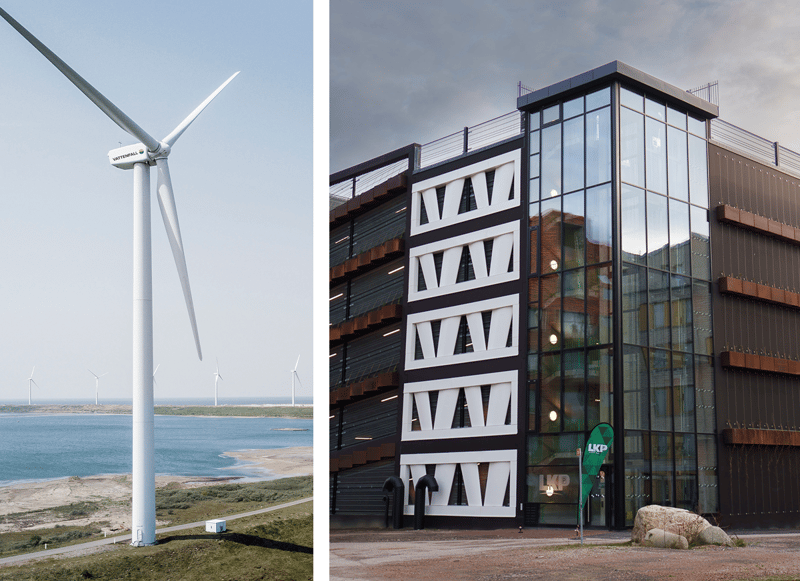
At Vattenfall, circularity takes many forms, from using fossil-free and recycled steel in solar parks and hydropower dam gates to experimental pilots repurposing wind turbine blades into parking garages or recycling the material into skis.
“We are exploring the diversity of opportunities right now. What is possible when it comes to circularity and what solutions provide benefit to Vattenfall? Pilot projects help to test new ways of working internally, but also how we cooperate with our suppliers and partners,” Annemarie Kerkhof concludes.
The Circular Changemaker’s Guide
The Guide was created within the Nordic Transition Group for Corporate Circular Transition, a collaboration facilitated by Cradlenet with eight large Nordic companies: Vattenfall, Elis, Kanthal, Mirka, Posti, Atea, Food Folk/McDonald’s and Danfoss.
The guide consists of interviews and a collection of “mechanisms”, that will help other companies ensure successful circular transition.
The guide will be released 12 November 2026. Register for the free online launch event and download the guide here.
See also
Why electrification cannot wait
When fossil-fuel prices rise, households and businesses feel the impact. Switching to fossil-free electricity can reduce that exposure. Europe worked hard to increase fossil-free electricity...
Vattenfall Business Area Wind maintains leader status in IRBC assessment
Vattenfall’s Business Area Wind has once again been recognised as a Leader in the IRBC assessment, reflecting continued progress in responsible and sustainable business practices.
There’s a way to build a solar park using low-emission steel
In its new German solar park Vattenfall is using recycled, low-emission, steel for the mounting structures, offering 67 per cent CO2 reduction compared to conventional steel.