
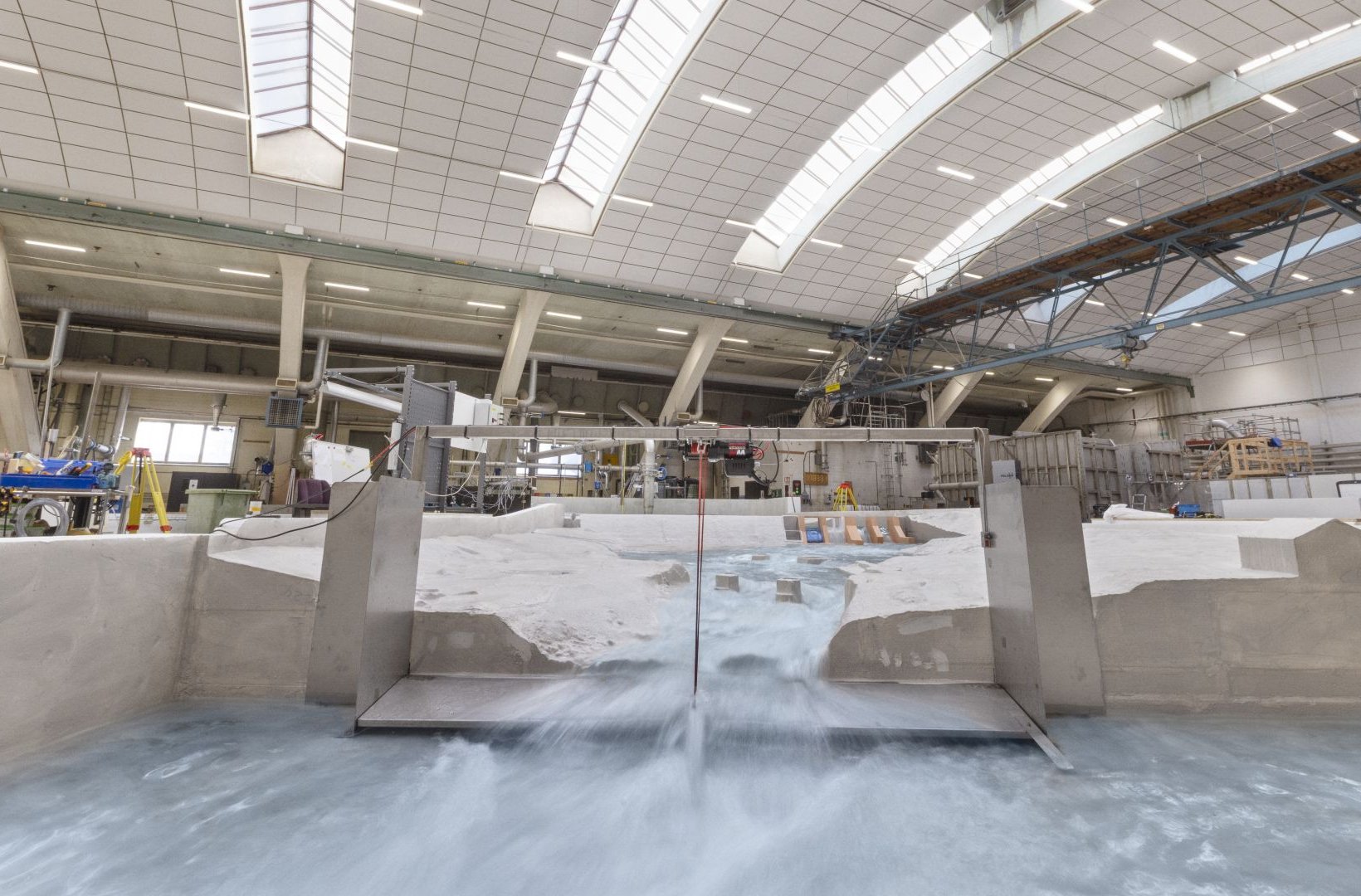
- The R&D centre in Älvkarleby advances hydropower with modern tools like drones and robotic inspections.
- The research focuses on improving existing technology rather than developing new breakthroughs.
- Projects include testing alternative concrete binders and evaluating new methods for dam monitoring.
- Researchers study how increased start-stop operation affects equipment wear.
- Large-scale physical models enable realistic testing before implementation.
Hydropower has been a reliable, stable and renewable part of the energy system since the late 19th century. However, this does not mean that it is fully developed. The Edit visited Vattenfall's R&D centre in Älvkarleby, Sweden, to see what the future holds for hydropower.
Mats Billstein, Vattenfall's portfolio manager for hydropower at the R&D centre in Älvkarleby, looks like a giant as he walks among the various models in the centre's largest hall. The light from the windows along the walls and in the ceiling glitters in the water rushing through the model of a hydroelectric power plant that forms part of the hangar-like premises.
“Here we have the opportunity to conduct large-scale experiments,” says Billstein. “The size of the models means that the results are very close to reality.”
Vattenfall's R&D centre is a building with a long history. Operations began back in 1943, but the oldest remaining parts are ten years younger. Since then, new parts have been added in a way that means the old premises are constantly encountering new technology: here, robot dogs roam freely on the hangar's steep stairs and dragonfly-like drones are sent out from the office building's roof terrace. The aim is for the drones to be used, among other things, to carry out inspection rounds in inaccessible environments around hydroelectric power plants or to examine turbines from the inside.
The centre is located in Älvkarleby, a small town in central Sweden that is perhaps best known for its high-quality sport fishing, but which is also an excellent environment for energy research. Its proximity to the Dalälven River, which flows quietly just outside the reception area, and the hydroelectric power plant located in the town made it a natural choice for the centre's location.
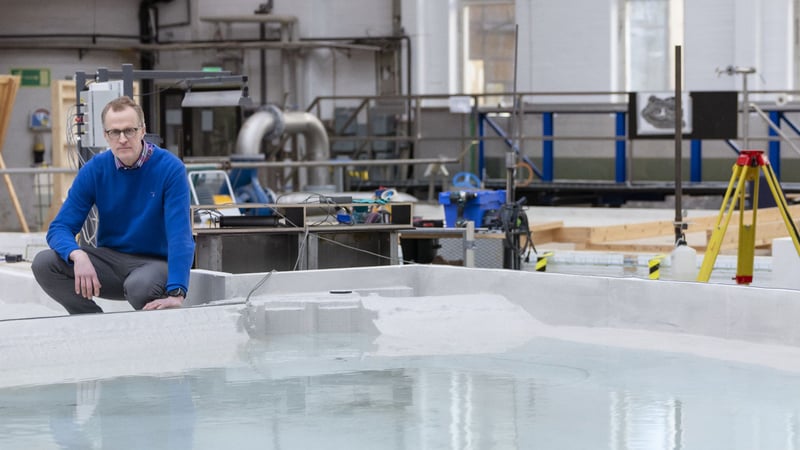
Mats Billstein, Vattenfall's portfolio manager for hydro power at the R&D centre in Älvkarleby, looks like a giant as he walks among the various models in the centre's largest hall.
Globally and locally important
Although there have been periods over the years when the focus has been on nuclear power or wind power, hydropower is something that the staff here constantly return to. Obviously for a reason – this power source continues to be one of the most important from a global perspective, but perhaps above all from a local perspective. Globally, hydropower accounts for around 15 per cent of total energy production and is the largest renewable source. For Sweden, that figure is over 40 per cent.
Like many of the buildings here in the Älvkarleby Centre, hydropower also has a long history. The plants began to be used on a larger scale as early as the late 19th century, and then grew steadily throughout much of the first half of the 20th century.
Improving and updating
Like many other things that have been around for a long time, are well established and work as they should, it is easy to take hydropower for granted. Its technology is established and production is stable.
“I don't see any revolutionary technological advances happening in hydropower,” says Billstein. “Much of the focus is on improving and updating what has worked well for so long, but also on coming up with solutions for things that could be better.”
In the concrete laboratory, for example, tests are being conducted with alternative binders to reduce the climate footprint of this key building material in hydroelectric power plants. The concrete is pressed, bent and pulled, all to see if it can replace more carbon-intensive and traditionally produced materials.
In one hall, the contour of an embankment dam can be seen. In here, a 20 meter wide and four meter high embankment dam was built according to standard procedures. Except for one big difference – the dam had several built in defects. The aim for the researchers was to evaluate different non-destructive geophysical methods for dam surveillance in this unique blind test. Now, the dam is dismantled, the results are under evaluation and the planning for the next test dam to be built is on-going.
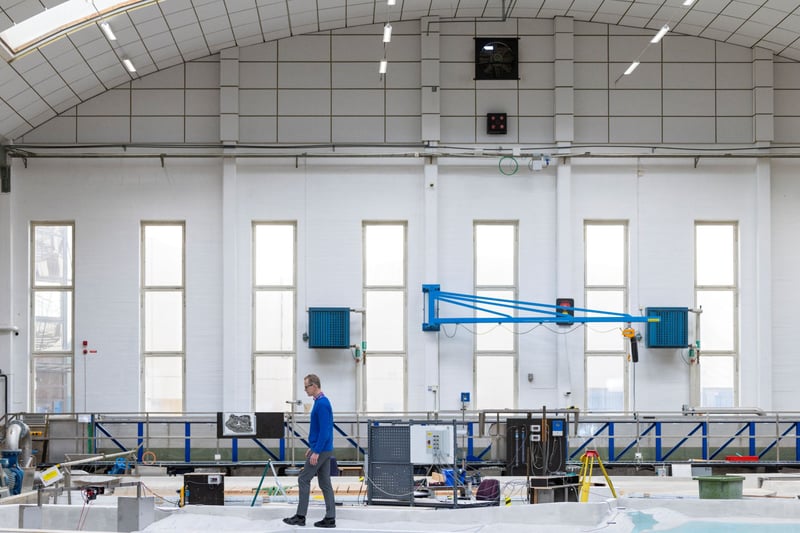
“Here we have the opportunity to conduct large-scale experiments,” says Billstein. “The size of the models means that the results are very close to reality.”
A new type of wear and tear
At the same time, consideration is also being given to using other, less carbon-based lubricants, as well as biodiversity, of course, with various solutions for both upstream and downstream migration for fish.
In an adjoining hall, a large generator model is also being tested by repeatedly starting and stopping it. The idea is to understand how generators wear out when hydropower becomes increasingly erratic as it balances out weather-dependent power sources.
“Future operations will involve much more starting and stopping, which will increase wear and tear on the facilities. We need to understand how this wear occurs and what drives it. This will help us to dimension and order the right plants and make it easier to use the right components that can cope with this changed mode of operation.”
World class laboratory capacity
Billstein takes us on a tour through the various stages that led the staff here to the giant model we see in the largest hall. We visit the workshop where some parts of the model are welded together and others are cut with millimetre precision. The idea behind building the large models is to make the circumstances and conditions as close to reality as possible.
“This is how we differ from academic research”, says Billstein. “Our research is very business-oriented. Most of what we do here will be implemented in one way or another. I usually describe our research as filling a toolbox. The more tools we have, the greater the likelihood of being able to solve the problems or meet the demands that society will place on Vattenfall in different situations.”
What is the most enjoyable aspect of working here?
“This environment and laboratory capacity are unmatched anywhere else in Sweden, and perhaps even in Europe. That is what makes it so exciting and enjoyable. We actually see the results of our research being implemented and put to practical use.”
Sign up for our newsletter THE EDIT
THE EDIT is Vattenfall's new monthly newsletter. Each issue highlights a new burning issue from the world of sustainable energy and fossil freedom.
See also
How algorithms are boosting pumped storage hydropower
Pumping water for hydro power production has been done for decades. But new algorithmic tools are now making this method even more valuable for grid stability.
How the snow that controls the spring flood is measured
When winter is at its peak, the Swedish mountain snowpack is measured to assess how much water the spring melt will release – a crucial task that shapres the annual cycle of hydropower.
Climate-smart material choices reduce emissions in electricity production
The climate impact of the energy sector is not just about how electricity is produced, but also about the materials used to build new facilities. This is why Vattenfall is working to introdu...