
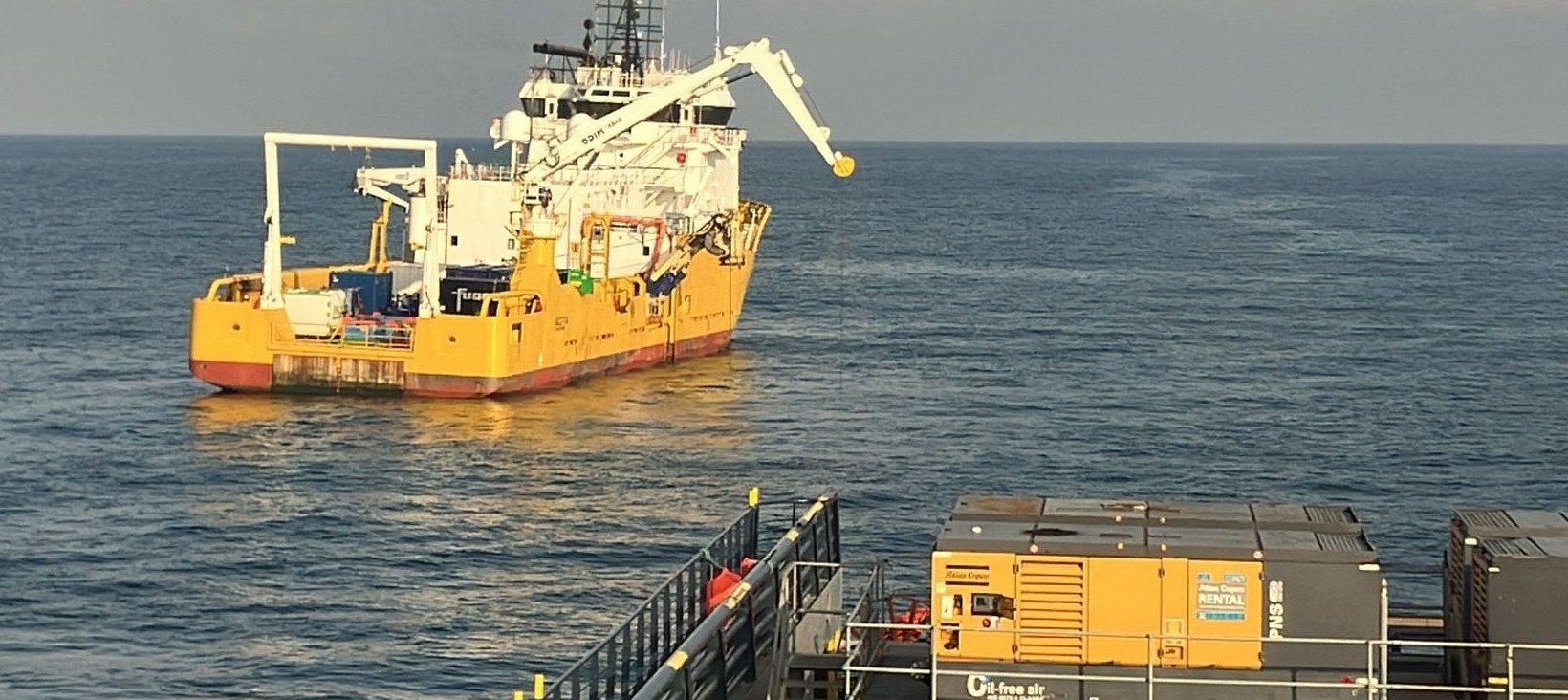
Sometimes the path to clean energy starts with a look into the past. Last year, the Nordlicht project's geoscience team completed a special campaign: to remove mines from the Second World War.
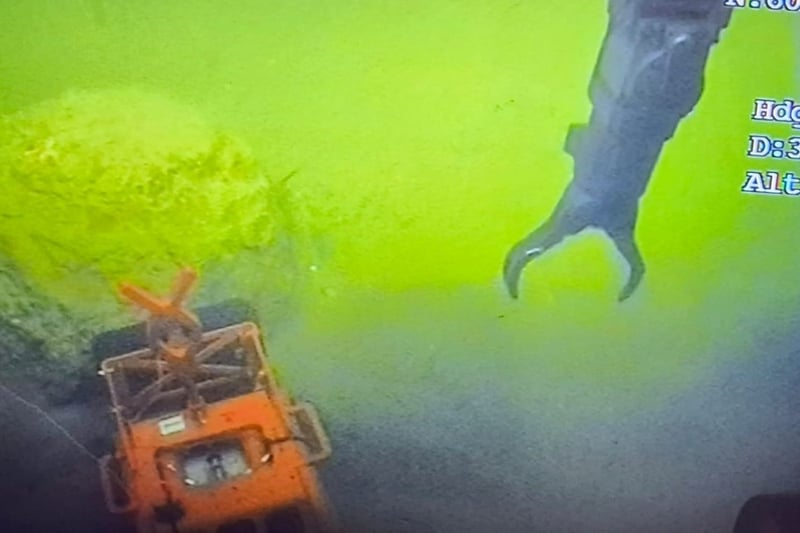
A Remotely Operated Vessel was used to neutralise the sea mines.
Nordlicht wind cluster facts
- Located 85 kilometres north of the island of Borkum in the German North Sea.
- Consists of two separate sites: Nordlicht 1 with a capacity of around 980 MW and Nordlicht 2 with around 630 MW.
- Once fully operational, electricity production is expected to total around 6 TWh annually.
- The wind farms are expected to be operational in 2028.
Many wartime remnants still lie dormant on the seabed and pose a real danger to people, technology and the environment. Therefore, before construction of an offshore wind farm can begin in the North Sea, these relics must be carefully identified and safely removed.
Metal objects were detected
Over the past two years, large-scale geophysical surveys of the seabed identified magnetic anomalies in the area of Nordlicht I and II, indicating the presence of metal objects. The anomalies were interpreted by experts as possible unexploded ordnance, or UXO.
During spring this year, each of the objects was examined and identified individually using a Remotely Operated Vehicle, ROV. As a result, three sea mines were discovered, each with an explosive charge equivalent to 200–300 kg of TNT.
In September, the time finally came, and after a complex permitting process, the objects were safely disposed of, through controlled detonations on site.
“Clearing the seabed of wartime ordnance is one of those invisible but vital steps in developing offshore wind,” says Tobias Kulgemeyer, Senior UXO Engineer at Vattenfall Business Area Wind and technical lead for the campaign.
“It takes meticulous planning, coordination and care for the marine environment. With this campaign successfully completed, we’ve laid the foundation for a safe and sustainable start to Nordlicht’s construction.”
Bubbles dampen explosions
A special aspect of this kind of underwater operation is the use of a 90-meter-long bubble curtain vessel. The vessel lays out a double hose ring on the seabed that generates a curtain of air bubbles to dampen the sound around around the detonation site, protecting marine life from noise and stress.
Also, as the approval notice prohibited simultaneous noise events in the German Bight, close coordination with other projects was necessary to avoid that to happen. In particular this was true for pile-driving work carried out by RWE in the area.
The Geoscience project team coordinated a total of seven vessels for the complex disposal campaign. These included smaller support vessels for deterrence and traffic safety, the bubble curtain vessel, and an ROV carrier vessel responsible for overseeing and executing the detonations.
With the seabed now safely cleared, the Nordlicht project is well-positioned to begin installation activities.
"We would like to thank all colleagues involved and our competent contractors at Fugro for the successful implementation," Kulgemeyer says.

A special vessel lays out a double hose ring on the seabed that generates a curtain of air bubbles to dampen the sound of the detonations.
Nordlicht wind cluster facts
- Located 85 kilometres north of the island of Borkum in the German North Sea.
- Consists of two separate sites: Nordlicht 1 with a capacity of around 980 MW and Nordlicht 2 with around 630 MW.
- Once fully operational, electricity production is expected to total around 6 TWh annually.
- The wind farms are expected to be operational in 2028.
See also
Vattenfall builds combined wind and solar park in south-west Germany
Hybrid park Hommerdingen-Biesdorf is Vattenfall’s first combination of wind and PV in Germany and sets standards for modern, cost-efficient, and grid-friendly energy generation.
First components for Nordlicht I completed ahead of schedule
The Nordlicht cluster has reached an important milestone before offshore construction is set to begin later this year: the first monopiles and transition pieces for Nordlicht I have been suc...
Climate-smart material choices reduce emissions in electricity production
The climate impact of the energy sector is not just about how electricity is produced, but also about the materials used to build new facilities. This is why Vattenfall is working to introdu...