
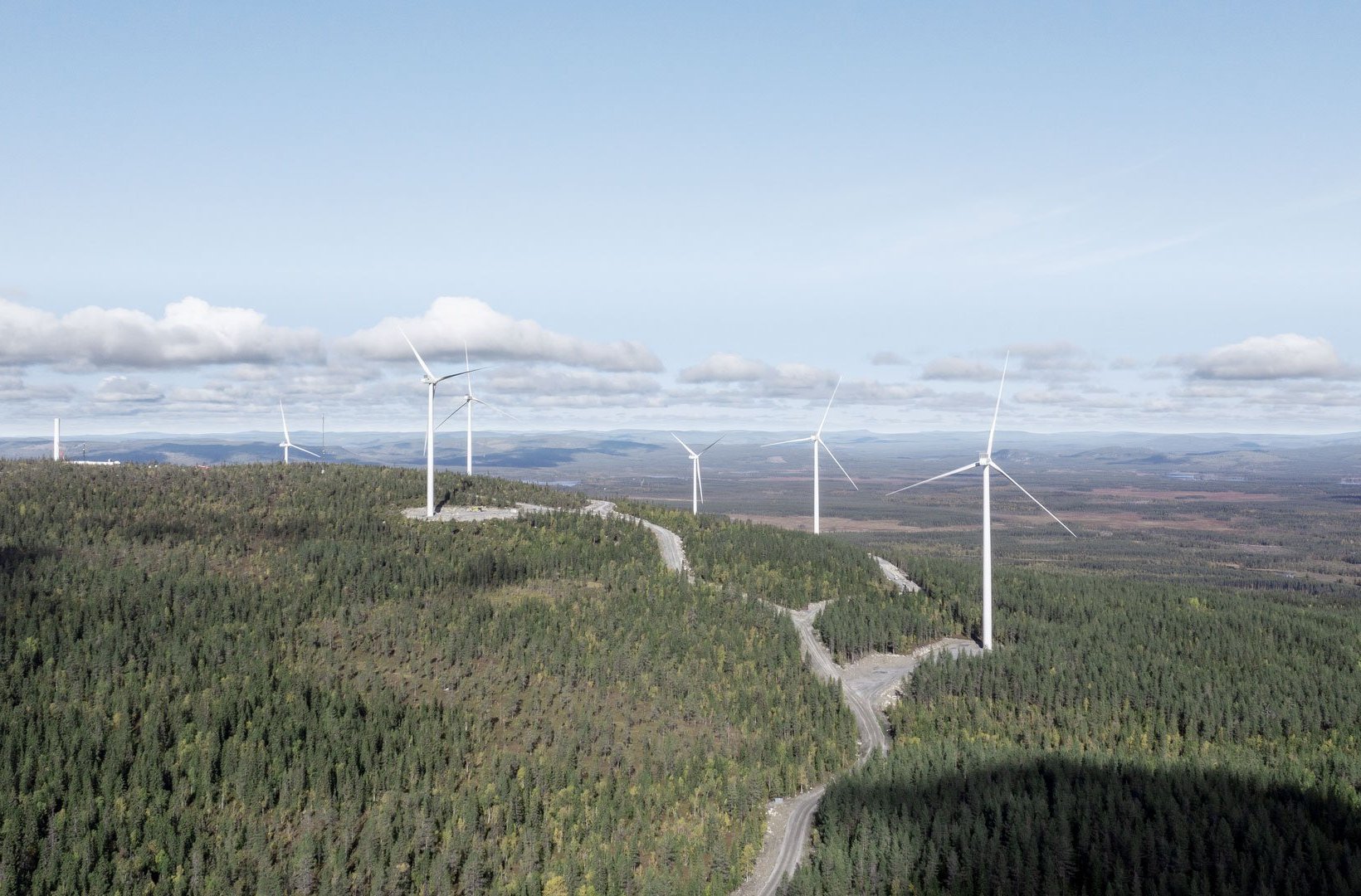
Vattenfall’s wind power reduces carbon footprint
The carbon footprint of Vattenfall’s wind power has now been reduced to 13 grammes per kilowatt hour generated, compared to 15 grammes in 2016, and the reduction trend only continues. The new Swedish wind farm Blakliden Fäbodberget landed at a record low 8 g CO2/kWh. In this case, this is a 47 per cent reduction in emissions compared to six years ago. In addition, the difference from fossil-based electricity generation is huge.
The positive downward trend for the carbon footprint of Vattenfall’s wind power continues. When compared with fossil electricity generation, it shows what a big difference new fossil-free electricity generation makes for the climate. From a life cycle perspective (Environmental Product Declaration, EPD), fossil-fired alternatives land at around 400–1100 g CO2/kWh.
"The new wind power environmental declaration makes it clear that new technology is pointing us in the right direction with its lower climate footprint per kilowatt hour generated. We are seeing a similar development for solar panels and other new technologies such as batteries. These technologies are highlighted in the IPCC report on reaching the 1.5 degree target as key technologies for reducing emissions from the energy sector and enabling climate transition and fossil free living within one generation," says Helle Herk-Hansen, Vattenfall's Head of Environment.
From a life cycle perspective on Vattenfall’s wind power portfolio as a whole, having a higher proportion of modern wind farms with a longer anticipated service life and higher generation are important contributing factors to reducing emission levels. Most CO2 emissions come from the extraction of raw materials, construction of components, the construction phase and transport. The analyses show that the greatest contributions to this downward trend come from shifting to fossil-free energy and making energy efficiency improvements in energy-intensive processes such as turbine manufacturing and raw material production throughout the life cycle.
"The recently inaugurated, partially owned Blakliden Fäbodberget goes to show how technological development and knowledge provide a rapid reduction in grammes of carbon dioxide per kilowatt hour. Life cycle assessments teach us how we can improve our own performance, engage in dialogue with suppliers and collaborate with developers to reduce environmental impact over time," says Helle Herk-Hansen, Head of Environment at Vattenfall.
Vattenfall’s strategy to enable fossil-free living within one generation covers the entire value chain. As such, Vattenfall is not only working to reduce its own carbon footprint by reducing emissions in line with a 1.5 degree scenario, but we also support our suppliers and customers. As part of Vattenfall’s commitment to reaching net zero emissions by 2040, the company has set a target to reduce emissions caused by purchased products and services by 50 per cent per kilowatt hour by 2030. In addition, Vattenfall are also striving toward recycling 100 per cent of spent wind turbine blades by the same year.
For almost 30 years, Vattenfall has been developing life cycle assessments to describe environmental impact, from cradle to grave. The calculations provide an indication of the environmental impact of the different stages of the life cycle.
Facts:
Electricity generation from lignite: approx. 1100 g CO2/kWh
Electricity generation from hard coal: approx. 800 g CO2/kWh
Electricity generation from natural gas: approx. 400 g CO2/kWh
Read more about: Environmental Impact of Wind Power - Vattenfall and Webinar: the Environmental Impact of Wind Power - Vattenfall
For further details, please contact:
Magnus Kryssare, Press Officer +46 (0)76-769 56 07, magnus.kryssare@vattenfall.com
Vattenfall Press Office +46 (0)8 739 50 10, press@vattenfall.com
See also
Thermal cameras shed new light on bird activity at sea
A thermal-camera and AI-system tested at Vattenfall’s Hollandse Kust Zuid offshore wind farm in the North Sea monitored bird movements around a turbine, day and night. As the technology work...
What it takes to build one of Europe’s largest offshore wind farms
In the German North Sea, the first visible signs of Nordlicht wind farm are beginning to emerge above the sea surface. By 2029, 112 wind turbines will make a strong contribution to the count...
Why showing up matters – beyond Pride Season
Vattenfall publicly advocates for the right of every individual to be themselves.