Risk and risk management
Our approach to risk management covers financial risks, strategic and non-financial risks, including sustainability risks.
Our industry is at the centre of societal development, national politics, and global geopolitics – all areas subject to volatility. Operating in a volatile environment means that we need to be equipped to manage the risks in an optimal way.
Our approach to risk management
At Vattenfall, we take a balanced approach to risk, evaluating business transactions from both profitability and risk perspectives. Our risk management practices are grounded in a strong risk culture that supports short-term objectives as well as long-term strategic goals.
Our risk management framework ensures thorough identification and management of risks, as well as the adherence to an acceptable risk exposure, Our Enterprise Risk Management (ERM), is based on international risk management standards such as the risk framework from the Committee of Sponsoring Organisations of the Treadway Commission (COSO) and the “three lines model" to support value creation, ensure risk awareness, and to balance risk against reward.
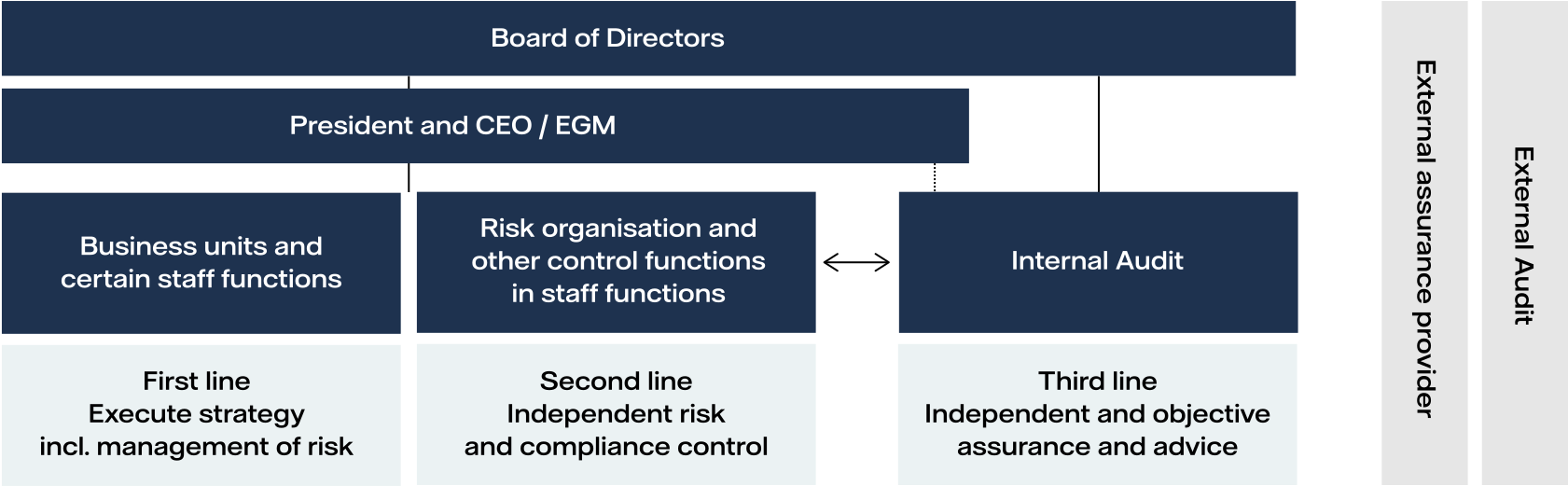
Vattenfall applies the three lines model for management and control of risks in general, based on the framework of the Institute of Internal Auditors.
Strategic and non-financial risks
Continued geopolitical instability and challenging market conditions are making security, defence and industrial competitiveness top priorities at the EU level. Growing demand for fossil-free electricity and flexibility presents not only risks but also opportunities for Vattenfall, influencing both our operations and strategic activities. With the increased focus on competitiveness, security and resilience, combined with increasingly challenging investment conditions for new renewable energy projects, it is important to time and prioritise investments very carefully.
In our risk management process, we quantify and analyse risks based on our long-term strategic objectives with respect to both financial and non-financial consequences.
Risks related to driving decarbonisation with our customers and partners
We promote electrification and decarbonised energy solutions in areas where we have a competitive advantage. We do this together with our customers and partners.
- Risk of loss of market share and customers because of inability to meet expectations of customers and partners. This risk also refers to the environmental risk of negative effects due to not meeting our climate targets as described in the sustainability statement under E1 (Transition climate risks) on page 85 in the annual report.
- Risk of insufficient regulatory frameworks to stimulate our (industrial) customers to decarbonise fast enough, for instance because of a slow specification and implementation of Clean Industrial Deal by EU member states. Also, this risk refers to the environmental risk of negative effects due to not meeting our climate targets as described in the sustainability statement under E1 (Transition climate risks) on page 85 in the annual report.
- Risk that technologies to decarbonise with, for example electricity, biofuels, or hydrogen, do not reach cost competitiveness
- Risk that customers are unable to pay their invoices or even go bankrupt.
Learn more about our risk management activities relating to this strategic area in our annual report: Annual and sustainability report (PDF 16 MB)
Risks related to connecting and optimising the energy system
We are focusing on maximising the value of flexibility and promoting a stable and cost- efficient grid infrastructure.
- Risk of inability to ensure adequate security of supply because of grid capacity constraints, extreme weather conditions, or delays in permitting processes for building new grids.
- Risk of inability to adapt appropriately to new technologies (including process automation) to cope with the increasing share of intermittent electricity generation and flexible demand.
- Risk of continued regulatory instability regarding the revenue frames for electricity distribution in Sweden.
Learn more about our risk management activities relating to this strategic area in our annual report: Annual and sustainability report (PDF 16 MB)
Risks related to securing a fossil-free energy supply
Our focus is on growth in renewables, maximising the value of our existing fossil-free assets and implementing our CO2 roadmap.
- Risk of reduction of electricity consumption due to macroeconomic downturn or other negative developments.
- Political risks such as changes in energy market design due to challenges in the energy market caused by networks stressed by increasing intermittent generation, national deviations in implementation of European energy policies and potentially increasing costs of electricity.
- Risk of re-introduction of subsidies causing a decrease of long-term market prices with corresponding repercussion on existing portfolio and ongoing investments.
- Risk of not being able to expand the fossil-free generation as planned because of difficulty in securing permits for example due to national security reasons or biodiversity impacts, such as environmental risks connected to negative impact on species as described in the sustainability section under E4 on page 96 in the Annual and sustainability report.
- Risk that economic feasibility of projects come under pressure because of surging prices for input material and procurement risk, including risk of increasing competition for critical and low carbon materials for construction of fossil-free assets. This risk also refers to the environmental risk of negative effects due to scarcity of resources as described in the sustainability section under E5 on page 102 in the Annual and sustainability report.
- Risk of not reaching growth ambitions, for example in the solar business, due to sustainability risks in the supply chain, such as suppliers failing in sustainability screening.
Learn more about our risk management activities relating to this strategic area in our annual report: Annual and sustainability report (PDF 16 MB)
Risks related to conducting high-performing operations
We are focusing on being both competitive and cost-effective and leveraging opportunities in digitalisation. We are also taking social and environmental responsibility throughout our value chain.
- Operational asset risks, such as power availability, dam failure, or environmentally hazardous emissions.
- Risks due to new or changing regulations, including sustainability and security related regulations, for example the Corporate Sustainability Due Diligence Directive (CSDDD) and the consequences of the different simplification Omnibuses.
- Geopolitical and supply chain risks, for example change in tariffs, constraints in supply chains, conflicts, and sanctions.
- Risk of project delays and cost overruns due to deteriorating project prerequisites during long lead times of large projects.
- Security and resilience risks, including physical sabotage, cyber threats, data leakage, and new or amplified risks stemming from the adoption of generative AI.
- Risk of not complying with regulations, for example GDPR, AI Act, EU Network and Information Systems Directive (NIS) 2, and EU Critical Entities Resilience (CER) Directive.
- Risk of fraud and unethical conduct which could disrupt operations and have negative impact on people and environment.
Learn more about our risk management activities relating to this strategic area in our annual report: Annual and sustainability report (PDF 16 MB)
Risks related to motivating and empowering our people
We are focusing on securing necessary competence while improving the employee journey and providing a safe work environment.
- Inability to secure or retain the competencies needed to succeed in delivering on our strategy and targets.
- Work environment risks related to accidents and incidents as well as risks regarding the mental health of employees.
- Inefficiencies and inability to ensure safe working environment due to pandemic risk.
Learn more about our risk management activities relating to this strategic area in our annual report: Annual and sustainability report (PDF 16 MB)
ESG risks
ESG risks can be identified by the businesses, respective staff functions (for example Environment, Health & Safety, Sustainability), or cross-functional projects and processes, such as the Double Materiality Assessment (DMA). Depending on their nature, the risks may be included in ERM, business risk registers, and/or reported on publicly in the Annual and sustainability report, as is the case for the DMA.
For information on the most recent ESG risks, as well as impacts and opportunities identified in the DMA, please see the DMA chapter of the Annual and sustainability report.
Annual and sustainability report (PDF 16 MB)
Our key focus is to enable fossil freedom that drives society forward. Accordingly, mitigating climate change and our roadmap to net zero emissions are our primary focus. Nonetheless, climate adaptation risks, including both physical and transitional, will have significant impacts over a much longer time horizon and are thus a dedicated area of study. See more information here (link to relevant climate page).
Financial risks
We actively manage key risk areas including market risk, funding and liquidity risk, credit risk, interest rate risk and currency risk.
Market risk
Market risk for electricity and commodities refers to the risk of adverse changes in electricity or commodity prices and is monitored daily. Market risk includes the risk of a change in volumes, especially in the Nordic market where hydro power production is highly dependent on precipitation.
Learn more about our market risk including risk management activities in our annual report:
Funding liquidity risk
Funding liquidity risk is the risk of Vattenfall not being able to finance short-term payment commitments or its longer-term capital needs. This may arise if asset values at maturity do not match liabilities and other derivatives.
Access to capital and flexible financing solutions is ensured through several types of debt issuance programmes and credit facilities.
Learn more about our funding liquidity risk including risk management activities in our annual report:
Credit risk
Credit risk is the risk that a counterparty cannot or will not meet its obligations to Vattenfall, the risk exists across all activities.
We have a strict framework for governing and reporting credit risks to ensure that risks are monitored, measured, and optimised so that the total credit exposure is kept at an acceptable level.
Learn more about our credit risk including risk management activities in our annual report:
Interest rate risk
Interest rate risk refers to the risk of negative impact from changed interest rates on the consolidated income statement and cash flow.
We quantify interest rate risk in our debt portfolio in terms of duration, which describes the average term of fixed interest.
Learn more about our interest rate risk including risk management activities in our annual report:
Currency risk
Currency risk refers to the risk of negative impact from changed exchange rates in the consolidated income statement and balance sheet.
Learn more about our currency risk including risk management activities in our annual report:
Related content
Find information on the structure of our corporate governance and reporting structure.
Vattenfall has formulated a strategy to reach our goal of fossil freedom.
The Vattenfall Group has four operating segments.