
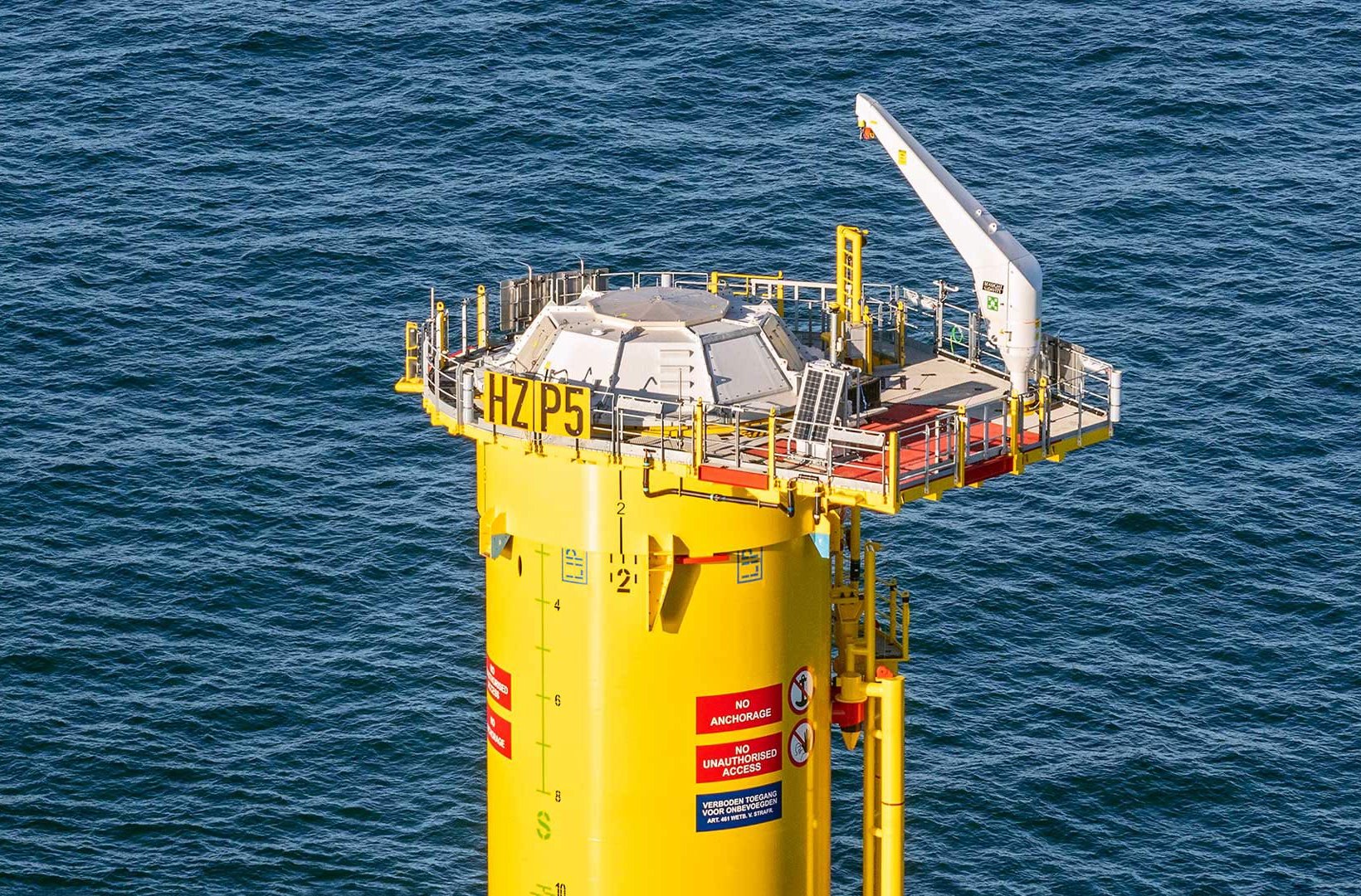
Before offshore wind turbines can be installed, their foundations need to be laid first. On top of each set of foundations stands a monopile with a cover, a temporary solution used to cap the huge tube. In the past, covers tended to be written off and destroyed after use. However, those used in the construction of the Hollandse Kust Zuid Offshore Wind Farm are durable, can be reused and will last as long as 10 to 15 years.
A monopile cover is a necessary stopgap in the stage between the foundations and the tower of a wind turbine being installed. It offers protection against seawater, rain and bird droppings. “Our people must be able to work safely around the foundations, while the cabling is being retracted, for example,” says Olaf Rick, Civil Works Package Manager at Vattenfall, who was involved in designing the sustainable monopile covers. In the past, covers used to be made of tent tarpaulin or aluminium. However, the tarpaulin was susceptible to wind and mildew and did not allow daylight through, while the aluminium tended to be scrapped after a single use.
Reusability
Vattenfall challenged its suppliers to come up with a sustainable alternative for the Hollandse Kust Zuid (HKZ) Offshore Wind Farm. CCM B.V., a start-up, designed a monopile cover made of fibre-reinforced polyester panels strengthened with steel beams and bolts. Weighing in at about one ton, the structure is relatively lightweight. It allows daylight and air to pass through the monopile and has, in principle, been designed for foundations with a diameter of seven metres. The design features not only material that can be reused over time, but also a cover that can be used several times over in the construction of other offshore wind farms. Rick: “The development process threw some significant challenges at us. The monopile covers had to meet multiple requirements. For example, they had to be lowered offshore using winches, they needed to allow cables to be brought in, and so on. We overcame some of these problems by using test rigs and running a series of tests. However, it became clear during the installation of the monopile covers that we could still make some improvements. Fortunately, CCM showed extreme flexibility when installing the 140 covers.”
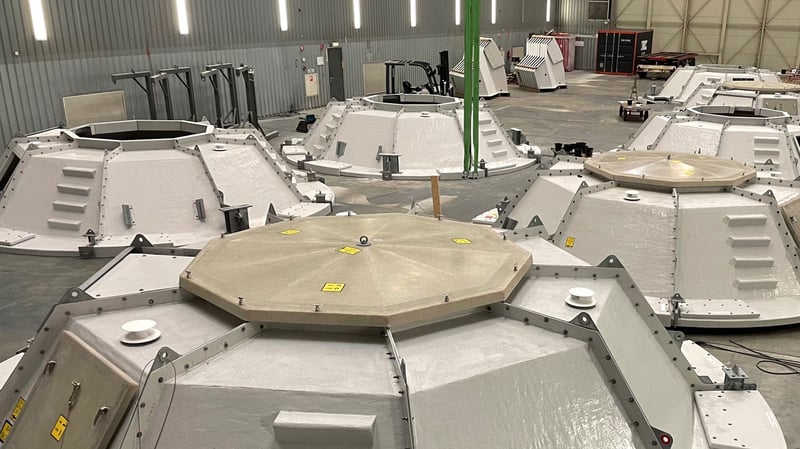
Some monopile covers in the hall of CCM’s factory
First customer
Vattenfall showing interest in renewable monopile covers got CCM off to a flying start in 2020. “We manufactured and assembled monopile covers for the HKZ and will reuse all covers in other offshore projects,” says Michiel Kraak, CCM’s Managing Director. “We have already found a customer for a vast majority of the covers. Vattenfall was our first customer and gave us the impetus to enter this market. That is extremely thrilling.”
According to Kraak, the secret of the polyester panels lies, among other things, in their interchangeability. “Redesigning the work platform of a newly built wind farm may allow various panels, e.g. entrance or translucent panels, to show themselves to be more useful in a different location. In addition, we can stretch the panels by making the metal frame they are attached to a little wider. This allows them to be used for monopiles with diameters of, say, eight metres or more.”
Selling and repurchasing
Another unique feature of the new design of the durable monopile covers was that CCM, the selling party, would buy back the covers after use under the sales contract concluded. “Because the covers are reusable, we will eliminate many additional CO2 emissions,” Kraak said.
He expects the individual panels to last as long as 10 to 15 years, depending on how often the diameter needs to be scaled up. Naturally, the panels become increasingly heavier as more metal spacers have to be placed between them for wind turbines with larger diameters. “Eventually, the time will come when the panels will reach the end of their service life. The steel will then be recycled. We are currently working with a party that can process the glass fibre-reinforced composite into new raw materials using a new technique. This allows all the material to be reused. We will soon be conducting some initial studies with a research institute to make sure this takes place. It would be really nice if we could actually launch this revolutionary new technique.”
CCM B.V. | Circularcovers.com
CCM originated from an European Union innovation programme. The region north of Amsterdam is home to a number of high-quality composites companies that benefitted from an EU grant scheme, part of the ERDF programme “Opportunities for the Western Netherlands (The Province of North Holland)” intended to encourage cooperation and innovation. This collaborative project was born of Vattenfall’s market demand for sustainable monopile covers for the HKZ.
Photos: CCM B.V.
See also
Collaboration and competitiveness in focus at Bruzaholm’s inauguration
The onshore wind farm in Bruzaholm has been inaugurated, marking a step forward for fossil-free electricity and strengthening regional electricity supply, flexibility and competitiveness.
What can the energy transition mean for European competitiveness?
European industries are still dependent on imported fossil fuels, which can increase energy prices – and create a situation where the continent will always be third best after USA and China....

When emissions become cheaper, the cost to Europe risks rising
As energy prices rise, pressure mounts to reduce the price of carbon emissions. But making the EU’s emissions trading system cheaper risks becoming a costly outcome for Europe – ...