
“We're halfway towards having constructed the world’s first offshore wind farm built without subsidies; a major milestone we can all be very proud of,” says Søren Andersen, Senior WTG Installation Package Manager Hollandse Kust Zuid at Vattenfall.
Speaking with Søren Andersen, you get a real sense of what it means to be building the, once in operation, largest subsidy-free offshore wind farm. It's a 24/7 job.
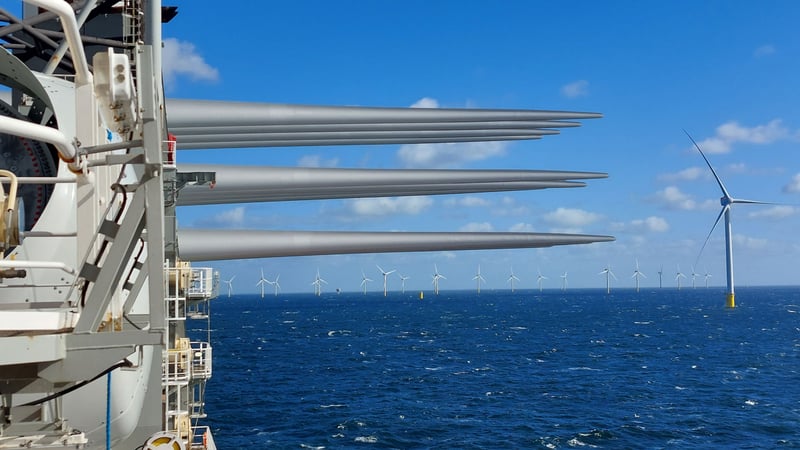
Cadeler's installation vessel Wind Osprey, which carries the turbine blades that will be installed later. Photo: Vattenfall/Charles Walker
Tough COVID protocol during installation
The crew working on the Cadelar Wind Osprey installation vessel started on April 2022 when COVID restrictions were still in place. “This meant testing procedures for each crew member, onboard quarantining and managing the logistical process within such parameters,” says Anderson. “While the strict rules and regulations were lifted for most people in the spring, the COVID protocol was maintained on the vessel until only a couple of weeks ago to prevent COVID outbreaks at sea.”
Getting the job done
The vessel makes round trips with four turbines per trip. Depending on the weather conditions, the trips take between five and twelve days. The crew work 12-hour shifts while on board in a two weeks on, two weeks off rotation. Unfavourable weather conditions can lead to the crew being delayed when transferring off the vessel and thus delayed getting home. This can easily take a toll on the morale of the crew. “A lot of credit must go to the installation team for continuing to stay on course and delivering the work, despite the challenges they may face,” says Andersen.
A high-level achievement
Delivering the work in itself is not a routine task either. It is the first time that the Siemens Gamesa 11 MW wind turbines are being installed in a serial setup and released for commercial production. The size and weight of the turbines require thorough engineering and planning to load them onto the vessel. “Realising such innovative and large-scale projects without subsidies is a high-level achievement in an energy industry like this,” says Andersen.
“Also, having biodiversity integrated into the design, with the creation of nature-inclusive designs, is really amazing and strengthens the motivation to deliver the project successfully,” mentions Andersen. “Creating fossil free living within one generation means generating renewable energy, while also preserving the marine ecosystem.”
See also
Vattenfall Business Area Wind maintains leader status in IRBC assessment
Vattenfall’s Business Area Wind has once again been recognised as a Leader in the IRBC assessment, reflecting continued progress in responsible and sustainable business practices.
Thermal cameras shed new light on bird activity at sea
A thermal-camera and AI-system tested at Vattenfall’s Hollandse Kust Zuid offshore wind farm in the North Sea monitored bird movements around a turbine, day and night. As the technology work...
What it takes to build one of Europe’s largest offshore wind farms
In the German North Sea, the first visible signs of Nordlicht wind farm are beginning to emerge above the sea surface. By 2029, 112 wind turbines will make a strong contribution to the count...