
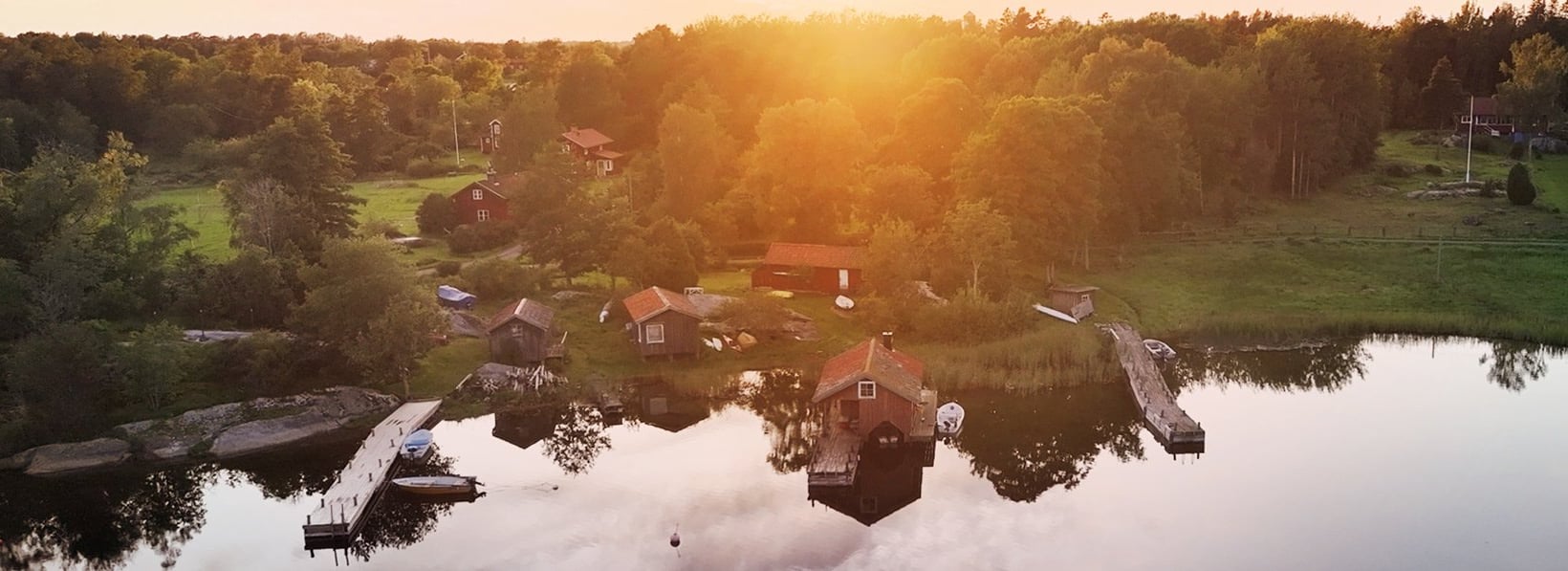
Arholma is one of the most beautiful islands in the Stockholm Archipelago. With solar panels and batteries, Vattenfall has designed a smart microgrid that enables Arholma to seamlessly go off grid.
The Stockholm archipelago is world famous for its 30.000 islands. In its far north lies Arholma island, which for many carries the essence of the archipelago beauty: pastoral red cottages with white trim lies scattered in the beautiful cultural landscape while barren cliffs gently descend towards the surrounding Baltic Sea. Not surprisingly, Arholma has been one of the most popular islands to visit for summer tourists for more than a century.
Today, groundbreaking technology is being pioneered at the island: advanced control of energy storage and solar panels makes it possible to cut the cord to the mainland without leaving the round 250 inhabitants in the dark for even a second. Should an outage happen, Arholmas grid is instantly switched to island mode, which means that it runs on its own microgrid resources, based on smart control of large energy storages and solar panels.
” The purpose of the project is to study how we can increase the resilience of the grid by using smart control, battery storage and local renewable power production,” says Niklas Sjöberg, Senior Innovation & Business Strategist at Vattenfall Eldistribution/Business Area Distribution. “Looking at the development of the surrounding world, it’s evident that we need grids that can withstand a big range of stress and strain.“
Register for our monthly newsletter THE EDIT
THE EDIT is Vattenfall's new monthly newsletter. Each issue highlights a new burning issue from the world of sustainable energy and fossil freedom.
Real time control
The Arholma microgrid was inaugurated in August 2023 and is a so called two hour system – meaning that the two 160 kW batteries are designed to support the whole islands for two hours, which is more than enough in the normal case of main land connection outage.
The most significant part of the system function is however the software solution that scans and controls the microgrid in real time, checks the flows of electrical current in every point as well as the status of the hardware in every moment. The constant surveillance detects a faulty mainland cable in a split second and activates the switches needed for the grid to run on its own resources.
The cutting edge project has already attracted international interest. During the autumn a large Japanese delegation visited Vattenfall to share experiences from similar Japanese island projects.
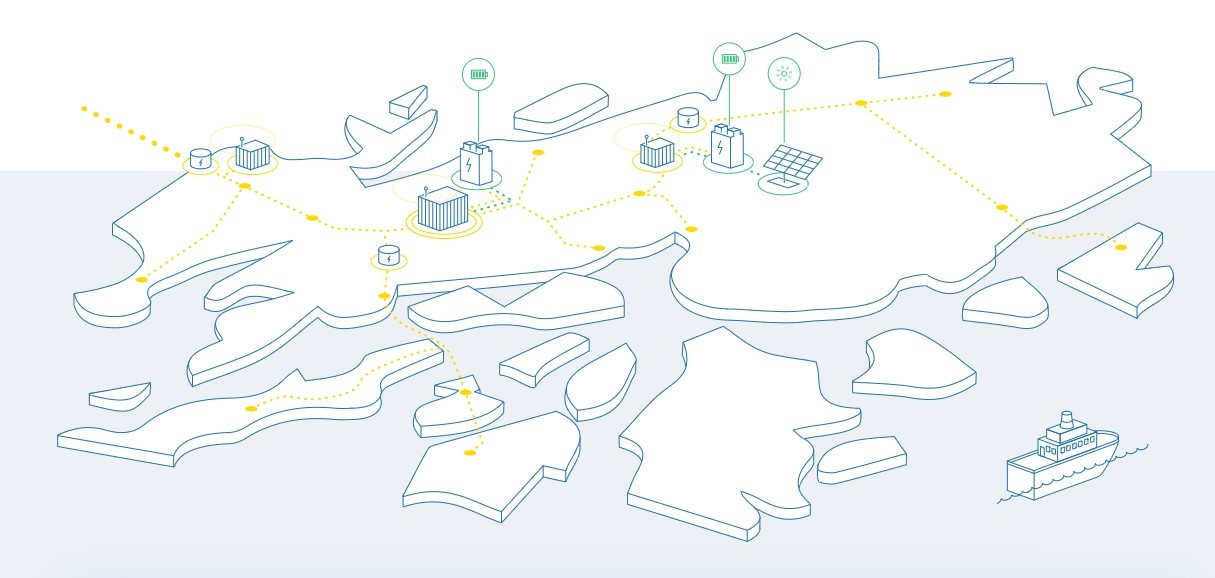 This is an illustration of the Arholma microgrid. Click this link and check out how the system is working at this moment.
Flexible customer demand
The next step of the project will be to involve the customers in the system, that is, the households and small enterprises on the island. The background for this is that the power consumption on the island has increased significantly since the system was designed in 2019. This means that the battery capacity is no longer enough to cover peak demand, especially in winter time. By including private electric heaters, heat pumps and roof-top solar panels in the microgrid control system, it will become much more flexible.
“Customer demand is the largest potential flexible resource in our grids, and we need to start utilising this possibility to bridge the capacity challenges. We want to be able to disconnect certain electrical load when needed, especially during winter when the load is high. This is particularly important after an outage, when we get back on the main land grid. Otherwise, if too many appliances and heaters are switched on, the grid may go down again,” says Niklas Sjöberg.
The technical solutions includes installing remotely controlled breakers in customer premises that can disconnect power consuming appliances for a while and instead connect them sequentially, to secure stability.
“We have seen a big interest from the customers on Arholma to participate, including some of the enterprises on the island,” Niklas Sjöberg says. “We are also looking in to the best ways to compensate the participants, principally with a discount on the grid tariff. In January we will start meet up with the customers, and map what appliances we would like to be able to control. We mainly look at the heating systems, heat pumps and electric floor heating.”
The project to make use of and optimize customer demand for the Arholma microgrid will be carried out during 2025.
See also
Trucks – a potential heavy player in the transition
The heavy transport sector is in the middle of a major structural shift. With more effective charging through Megawatt Charging System (MCS), with twice the effect as its’ predecessor, truck...
Taking the lead in a crowded charging market: the next step in electric driving
Electric driving is growing rapidly across Europe. But without reliable, affordable and smart charging infrastructure, that growth will stall. As markets mature, new pressures are emerging. ...
Huge road and tunnel project in the UK aims to reshape construction for the future
Construction is one of the hardest sectors to decarbonise. But in the UK, a major infrastructure project aims to reach carbon neutral by using electric machinery and low‑emission materials.