
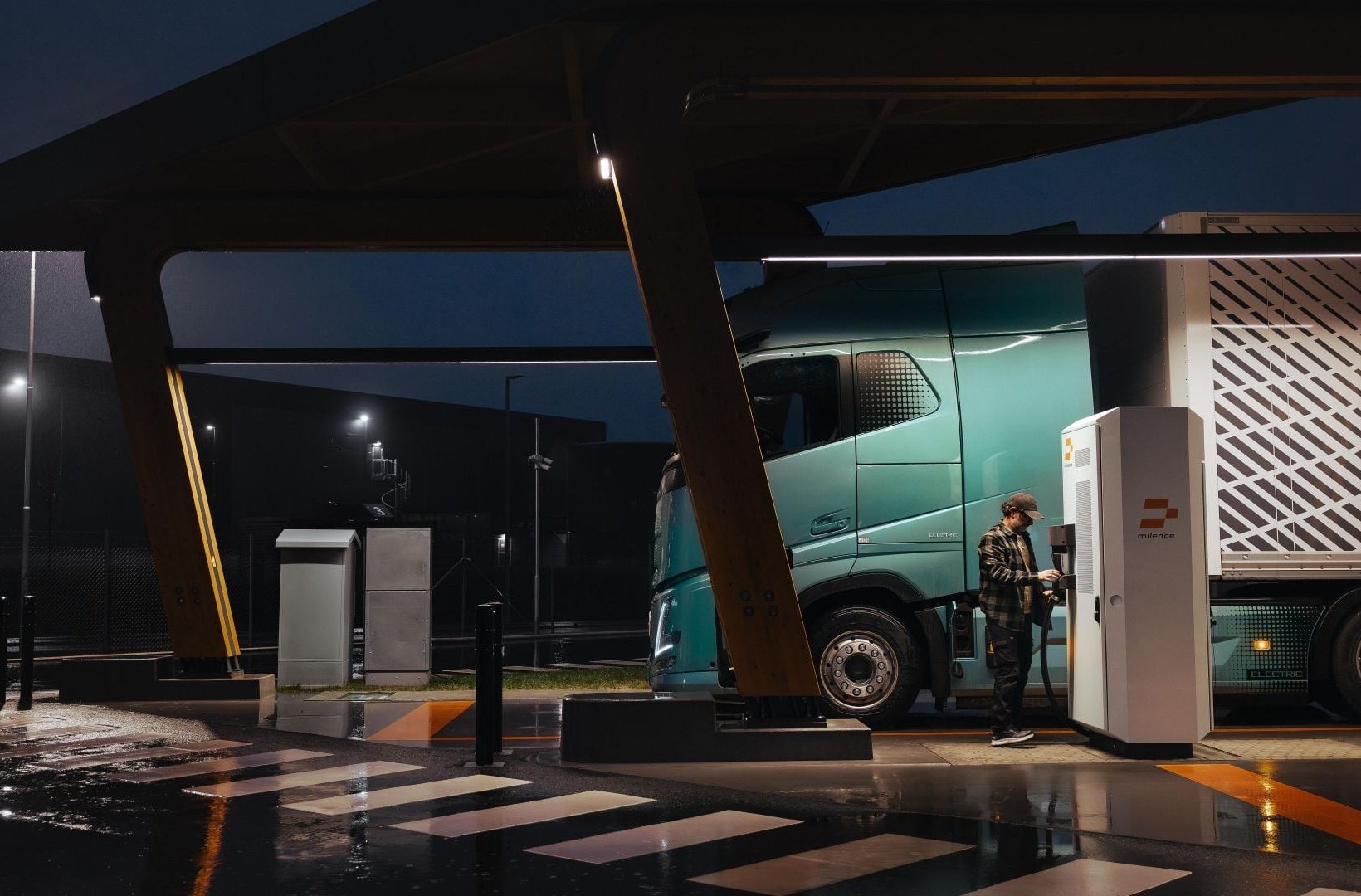
- The heavy transport sector is undergoing a structural shift, with electric trucks expected to play a larger role in reducing emissions.
- The new Megawatt Charging System (MCS) enables significantly faster charging, making longer routes and more flexible operations possible.
- Limited grid capacity, long lead times and access to power remain key challenges for scaling electric trucks.
- Electrification is driving a broader system change, where trucks, charging and energy systems are increasingly integrated.
The heavy transport sector is in the middle of a major structural shift. With more effective charging through Megawatt Charging System (MCS), with twice the effect as its’ predecessor, trucks could play a major role in the energy transition. What changes will the new charging standard bring?
Transport accounts for just over a quarter of the EU’s carbon dioxide emissions. If that figure is to fall, heavy road transport – buses and trucks – will be a crucial part of the transition. Under EU requirements, manufacturers must cut CO2 emissions by 43 percent by 2030, 65 percent by 2035 and 90 percent by 2040.

Niklas Pederson, Project Manager at Scania.
According to Niklas Pederson, who works with electric truck sales at Scania Sweden, the shift to electric trucks is already on the way. One remaining challenge is access to electricity. Charging electric vehicles is generally power-intensive, and that challenge only grows when the vehicles – and their batteries – are larger.
“The system is still very reactive and slow, because laws and regulations are by nature slow. The restrictions and lead times involved in getting power to where it is needed are difficult for a haulage company to manage,” Pederson says.
“Many customers say they should have started installing chargers long before they even considered switching to electric trucks. The whole process of securing power takes such a long time,” adds Catharina Qvist, Head of Sustainability at Scania Sweden.
Major charging change will reshape routes
In the coming months, a major technology shift will also be introduced – one that could further increase the pressure electric trucks place on the power system. For a long time, electric trucks, like passenger cars, have used the Combined Charging System, CCS. But with the new Megawatt Charging System, MCS, charging could become up to ten times faster than with CCS.
That would allow an electric truck to charge sufficiently during the EU-mandated 45-minute breaks that drivers are entitled to after every 4.5 hours of driving. If a truck can charge from, say, 20 to 80 percent during such a break, operators can plan for longer routes and more assignments.
“Our customers are profit-driven companies that need to keep their vehicles running as much as possible. Combining driving and charging has been a puzzle. If you can reduce charging time, it becomes much easier to plan. The break is shorter, and you can stop without unnecessarily disrupting the logistics schedule,” Pederson says.
The first electric trucks with MCS will reach the market in the second half of 2026. With the new standard, charging capacity will double, from around 375 kW to 750 kW. MCS also enables better communication between the charging infrastructure and the truck, making the solution more reliable, robust and predictable.
“Expanding the grid so that it can handle MCS would take several years. That is already one of the major limitations. Neither electricity subscriptions nor grid expansion rules are adapted for heavy vehicles charging at 750 kW. The system was built for base industry. We need a more flexible system, where your electric truck can charge heavily at night without being penalized by high subscription fees just because you need fast charging at some point during the day,” Pederson says.
According to Jessica Sandström, Volvo’s Senior Vice President of North and Central Europe, depot charging is easier for companies to build and control themselves.
“Today, companies are starting by electrifying flows that are highly predictable, where they know they will drive from point A to point B. You can control both endpoints – perhaps you even own both. But with the new range now available, many more and longer transport assignments become possible,” she says.
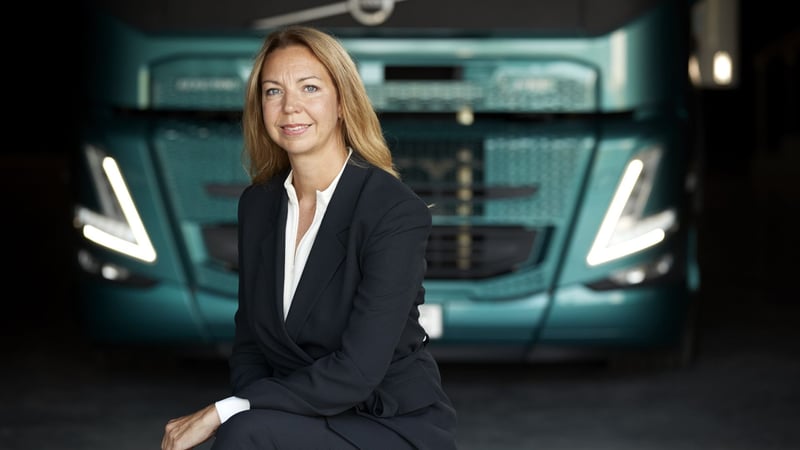
Jessica Sandström, Senior Vice President for North Central at Volvo. Photo: Volvo.
Roland Schurig, Head of UnitZERO and Zero Emission Projects at MAN Truck & Bus, emphasizes that depot electrification goes far beyond installing chargers. It is about transforming every depot into an integrated energy system – combining vehicles, infrastructure and energy into a controllable cost and performance advantage.
“Electrification turns from a technical topic into a structural competitive advantage. As our customers integrate trucks, charging and energy into one system, they fundamentally improve their total cost of ownership – and with it their cost per kilometre. Once fleets integrate vehicles, charging and energy, they structurally lower cost per kilometre. Those who achieve that will win tenders, gain market share and outperform diesel competitors. In that sense, electrification is not just a transition – it is a competitive shift. That is why it is a true game changer, he says.
If you build roadside charging, they will come
At the same time, depot charging is only one part of the charging challenge. Just as important is the expansion of MCS charging along Europe’s roads.
“The next step is scaling electrification beyond controlled depot-to-depot operations into pan-European corridors. This requires both – trucks with higher range and a reliable high-power charging as well pan European public infrastructure with competitive energy pricing across Europe by 2030,” Schurig says.

Roland Schurig, Head of UnitZERO and Zero Emission Projects at MAN Truck & Bus.
For Jessica Sandström, access to charging is ultimately about security for diesel-powered transport companies that want to electrify their fleets. Many drivers already manage today through determination and ingenuity – they simply solve the charging problems that arise. But for a broader breakthrough, the system needs to be reliable. Companies must know that charging is available along Europe’s major transport corridors.
“Public charging is where most customers feel the pressure today. Can I get enough power to my depot? Can I get it quickly enough? And how many trucks will I actually be able to charge? If you buy your first ten electric trucks, charging is usually not a problem. But when you start scaling up and want a hundred trucks in the yard, you need a completely different power output. Many of our customers experience the process as slow, difficult to predict and extremely costly – especially if they need to secure higher power capacity where it is not already available.”, Sandström says.
A bumpy road – with sunrise on the horizon
Despite the challenges, electric truck manufacturers remain optimistic. The energy crisis caused by recent years of wars and conflicts has further underlined the importance of fossil independence.
“If we had more electric trucks with easy access to low carbon energy in Europe, the transition towards a self-reliant energy system would become easier and faster. At the same time, progress varies across the continent. Some countries have barely started, while the Netherlands and Switzerland, for example, have come a long way. These are also countries with a much clearer, more holistic plan. They ask: What do we want as a country? If you want to make the transition at a national level, you also make political decisions that support it, through incentive programmes and CO2-based tax systems. In the Netherlands, they have introduced zero-emission zones where, in some places, you cannot enter at all unless you meet the requirements,” Sandström says.
All the electric truck manufacturers interviewed by The Edit stress that development is moving in the right direction – not least because electrification is the only realistic path forward.
“Many of our customers have already become more curious about how they can charge faster, generate their own electricity, install solar panels and use batteries. They are looking at how to optimise operations. Can they do one more round on the same charge? Can they get an exemption from the municipality to drive at night because the truck is so quiet? This is a major system change – and it is making us even more innovative,” Qvist says.
Competition from China
In recent years, the biggest advances in electric vehicle development have taken place in China, where manufacturers have scaled up electrification and driven down prices. So far, however, this has mainly involved passenger cars.
Could the same development happen in heavy transport? Will Chinese electric truck manufacturers be able to challenge European players?
For European electric truck manufacturers, there are two ways to view increased competition from China. On the one hand, tougher competition may be difficult for European manufacturers. On the other, it will push innovation.
“The more manufacturers that offer electric trucks, the stronger the signal to everyone that this is the future. But it is important that we compete on equal terms. That is where our focus lies,” says Jessica Sandström, Volvo’s Senior Vice President of North and Central Europe.
According to Schurig, Chinese electric truck manufacturers are competitive in areas such as battery capacity and charging times, but the European giants have clear advantages.
“When it comes to purchasing trucks, it is simply speaking 50 percent the truck itself and 50 percent beyond the truck – meaning service network and uptime, sales relationship, trust and partner mindset. In that respect, European manufacturers have a clear advantage. But when the prices by new competitors are lower, some customers will always have a look at other offerings.”
For European manufacturers such as MAN, Volvo and Scania, the challenge is simply to embrace the competition from Chinese rivals.
“Competition will always accelerate the market. It raises the bar on cost and technology and service processes – and forces us as European OEMs to improve every day. In the end, customers benefit from better products and faster innovation. And if someone is better in certrain areas, we will get better. It is all part of the game,” Schurig concludes.
Register for our monthly newsletter THE EDIT
THE EDIT is Vattenfall's new monthly newsletter. Each issue highlights a new burning issue from the world of sustainable energy and fossil freedom.
See also
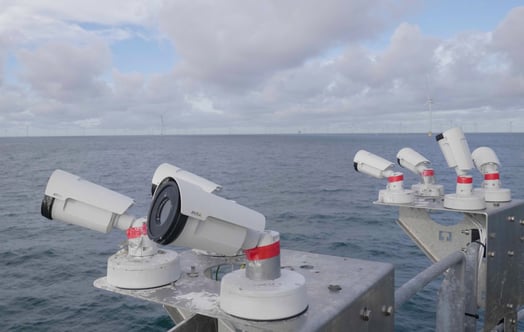
Thermal cameras shed new light on bird activity at sea
A thermal-camera and AI-system tested at Vattenfall’s Hollandse Kust Zuid offshore wind farm in the North Sea monitored bird movements around a turbine, day and night. As the technology work...
What it takes to build one of Europe’s largest offshore wind farms
In the German North Sea, the first visible signs of Nordlicht wind farm are beginning to emerge above the sea surface. By 2029, 112 wind turbines will make a strong contribution to the count...
Giant water heater makes district heating more flexible
In Diemen, the Netherlands, Vattenfall converts renewable electricity into heat for thousands of households.