
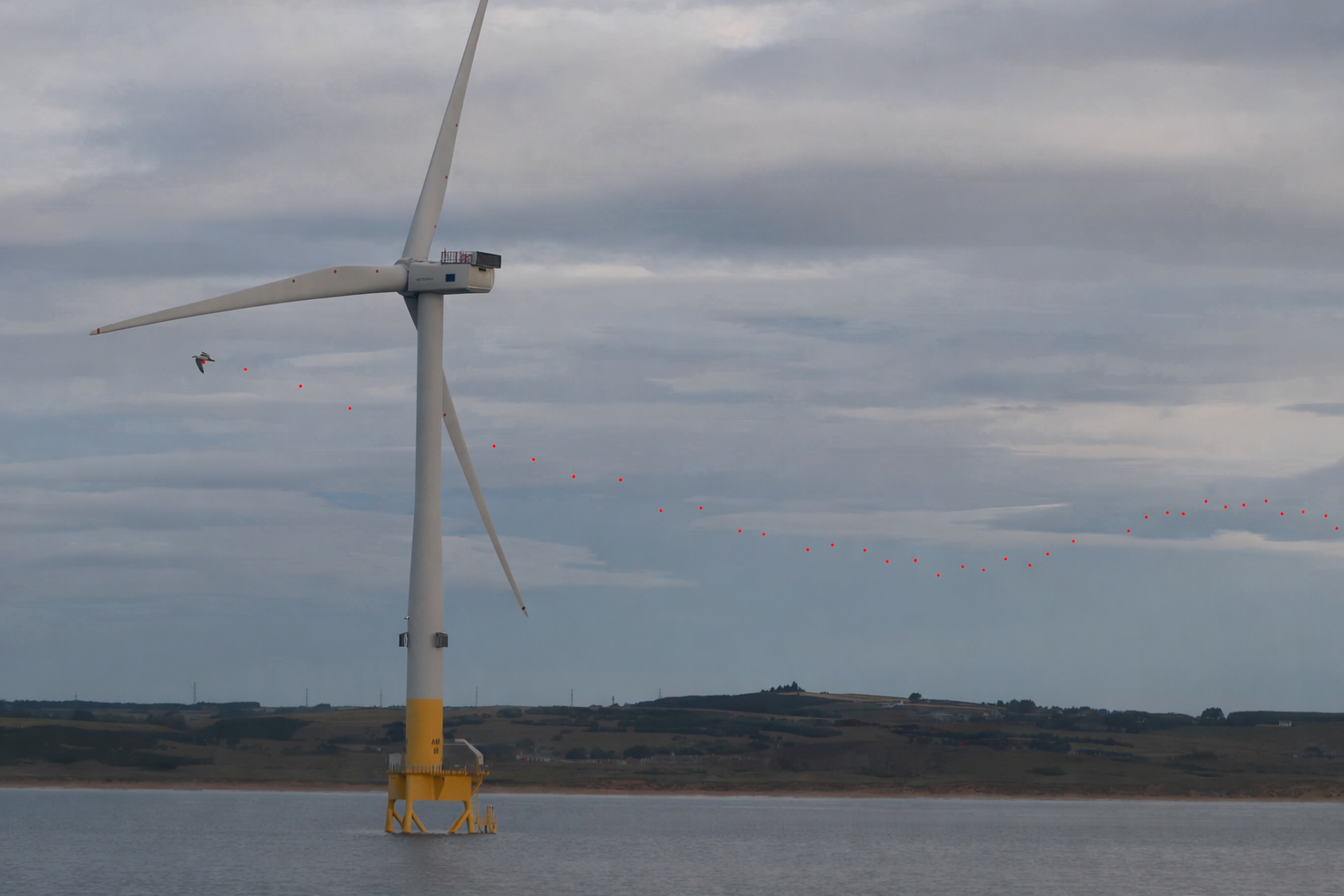
New Aberdeen study finds seabirds steer clear of turbine blades
- No bird collisions were detected during 19 months of monitoring at Vattenfall’s Aberdeen offshore wind farm.
- Monitoring shows that collisions are very unlikely - less than one was estimated during the whole study period.
- The monitoring shows that the wind farm is affecting birds far less than previously predicted before the wind farm was built in 2018
A detailed new collaborative study between Vattenfall and Spoor, a biodiversity technology company specialising in AI-powered bird monitoring, has confirmed that seabirds are safely steering clear of offshore wind turbines at Vattenfall’s Aberdeen offshore wind farm.
Using AI supported by extensive manual inspection, the research analysed video footage from 19 months of continuous monitoring of one of the Aberdeen turbines, between June 2023 and December 2024. The equipment captured around 95% of daylight hours and recorded 2,007 bird flight paths near the monitored turbine.
Five flight paths were initially identified as potential collisions. However, after review, none were found to involve an actual collision. In most cases, the birds were well away from the turbine or displaying natural behaviours such as diving for food.
This monitoring suggests that the wind farm is having a far smaller impact on seabirds than originally predicted before it was built in 2018, which is encouraging for seabirds living alongside wind farms.
The evidence will help inform construction of future offshore wind projects by giving developers and regulators greater confidence that turbines can operate with a lower impact on seabirds and make environmental assessments more accurate.
These findings also align with results from previous radar, camera and GPS tracking work at Aberdeen, which show that seabirds typically avoid turbines at distances of 100–200 metres. This natural avoidance behaviour is now understood to play a major role in keeping collision rates low.
Dr Eva Julius-Philipp, Director of Environment and Sustainability at Business Area Wind at Vattenfall, said:
“This study adds to a growing body of evidence showing how seabirds can avoid offshore wind turbines. The findings from Aberdeen Bay demonstrate that modern offshore wind farms can be operated with low risk to wildlife, especially when supported by robust, real-world monitoring. We remain committed to using the best available science and evidence to protect the natural environment while delivering low-carbon electricity.”
Ask Helseth, Chief Executive Officer and Co-founder of Spoor, said:
“This study demonstrates the value of long-duration, real-world monitoring in understanding how seabirds interact with offshore wind infrastructure. By combining AI-supported detection with detailed expert review, we can move beyond assumptions and measure actual behaviour at turbine scale.
“The results from Aberdeen provide important evidence that avoidance behaviour plays a significant role in reducing collision risk, and they show how modern monitoring approaches can support more accurate environmental assessments for future projects.”
Notes to editors
- Click here to read the full report
- The Spoor system used a single high‑resolution camera mounted on turbine AW10 to monitor bird movements around a neighbouring turbine, AW05. It operated for around 95% of daylight hours and automatically detected and tracked birds as they passed through the camera’s field of view, recording their flight paths, speeds, distances and heights.
- The system flagged any movements that might indicate a possible collision, allowing experts to review the footage in detail. Although a small number of clips were flagged, further analysis showed that all were false alarms, demonstrating both the sensitivity of the system and the importance of expert review.
- The camera system recorded 2,007 bird flights over 19 months and detected zero confirmed collisions. Although five clips were flagged as possible collisions, detailed review showed that in every case the birds were either far from the turbine or carrying out natural behaviours such as diving for food.
- Calculations based on observed bird activity carried out by The Biodiversity Consultancy, who produced the report, showed that only about 0.002 bird collisions would be expected over the entire 19‑month period. That is far lower than predictions made before the wind farm was built. This earlier assessment suggested that each turbine could cause an average of 8.54 collisions a year, which would have been about 13.5 collisions over the same 19 months.
- The report also highlights the growing value of modern monitoring tools. While this study used a single camera setup, newer stereoscopic systems can map bird movements more precisely and more efficiently reduce false alarms when identifying possible collision events.
- Image credit: Spoor
See also
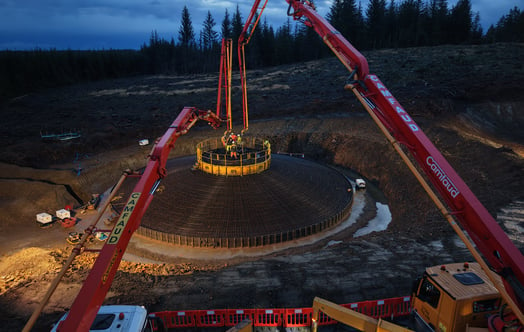
Lower-carbon foundations completed at Clashindarroch II wind farm
Vattenfall has completed all 14 turbine foundations at its 63MW Clashindarroch II Wind Farm in Aberdeenshire, a major construction milestone delivered in 11 weeks.
Early work starts on proposed Adlingfleet wind farm
Vattenfall is exploring proposals for a new onshore wind farm in the East Riding of Yorkshire and North Lincolnshire.
Vattenfall unveils plans for two new onshore wind farms in East Anglia
Vattenfall has revealed plans to develop two new onshore wind farms in East Anglia.